Watch this space: a new strategic direction for UK media - green paper and public consultation
Updated 29 July 2026

© Crown copyright 2026
This publication is licensed under the terms of the Open Government Licence v3.0 except where otherwise stated. To view this licence, visit nationalarchives.gov.uk/doc/open-government-licence/version/3 or write to the Information Policy Team, The National Archives, Kew, London TW9 4DU, or email: psi@nationalarchives.gov.uk.
Where we have identified any third party copyright information you will need to obtain permission from the copyright holders concerned.
This publication is available at https://www.gov.uk/government/consultations/watch-this-space-a-new-strategic-direction-for-uk-media-green-paper-and-public-consultation/watch-this-space-a-new-strategic-direction-for-uk-media-green-paper-and-public-consultation
Presented to Parliament by the Minister for Creative Industries, Media and Arts by Command of His Majesty.
June 2026
© Crown copyright 2026
CP 1594
ISBN 978-1-5286-6429-5
Ministerial foreword
Like many of us, evenings in my home growing up were often spent gathered around the living room TV set. Whether that was the whole family glued to the Generation Game or Noel’s House Party on Saturday night, or cheering on Scotland in the football.
Our media is a central part of our civic realm. High-quality television programmes, like culturally relevant drama and comedy, provide common references and help shape attitudes to social issues. Trustworthy news, subject to rigorous editorial standards, provides the shared understanding and facts needed for people to trust one another. The broadcast of national moments, such as the Olympic Games or international sporting fixtures, bring the nation together for shared experiences.
However, these benefits are under pressure in today’s media environment where a limited selection of broadcast channels has given way to an explosion of seemingly unlimited content, accessed primarily via the internet. The digital age has seen audiences move away from traditional linear broadcasting and into the online world where, rather than watching together, we are encouraged to consume content in individually curated feeds, and divisive and inaccurate narratives are more likely to thrive.
This green paper sets out a new strategic direction for the government’s media policy to address these challenges. The interventions we are consulting on will:
- foster a healthy information environment where trustworthy news is easy to find
- ensure audiences can continue to enjoy universal access to trusted and high-quality television content and benefit from our modern digital society more broadly
- support our public service media providers, who sit at the heart of our domestic TV industry ecosystem, driving growth and inward investment
Taken together, this work will ensure that our media continues to play its vitally important roles in entertaining, educating, serving democracy and supporting social cohesion in the UK, while putting audiences first.
Ian Murray, Minister for Creative Industries, Media and Arts
Executive summary
At its best, our media provides the basis of a cohesive country and a healthy democracy. It has the power to advance shared understanding, shared facts, and shared experiences which help people trust and understand one another. It is this common ground on which a country is built.
However, like so many of our other civic spaces, it is facing fundamental challenges which are putting these benefits at risk. Television is undergoing a profound and rapid transformation, having moved from a system of limited broadcast channels to an environment of ‘content everywhere’, where the largest players are global streaming services, video sharing platforms, and social media companies. Our domestic broadcasters, including our public service media, are fighting to be seen and heard in an increasingly competitive and fragmented market. People are increasingly accessing news online, rather than through more regulated spaces like Freeview on their TV sets. This is weakening the ability of trustworthy news providers to reach audiences and shape informed public debate.
We are navigating a storm, but we have a strategy to address these challenges. One not designed to stop change, but to put technology in our service, not us in its. This green paper is part of that strategy and sets out an ambitious plan to ensure the media, and television in particular, can continue to play its vitally important role in our society and our democracy, by ensuring high-quality UK content and trustworthy news remains accessible and sustainable for the next generation.
Chapter 1: Market and audience context
The constraints that once defined television, finite spectrum requiring licensing and strict content standards, are being removed by technology. Today’s audiences have access to a near infinite amount of content, and are shifting away from traditional live TV. This is particularly true for younger viewers.
This digital shift is blurring the lines between traditional, regulated TV and online content. Platforms like YouTube are increasingly hosting high-quality, TV-like programmes. Crucially, global technology platforms now often control the algorithms that decide what content people see. These algorithms typically prioritise engagement over value, risking ‘filter bubbles’ that erode the shared cultural experiences once provided by broadcasting.
This environment puts significant financial strain on our domestic public service media (PSM) providers, the BBC, ITV, Channel 4, 5, STV, and S4C [footnote 1]. Their advertising and licence fee revenues are declining, while competition for high-end content is intense. While our domestic production sector is globally successful, it faces pressure from rising costs and challenges retaining intellectual property (IP), shifting commercial value overseas. We must support the sector to diversify funding, retain IP, and ensure PSM continues to champion high-quality, distinctive UK content that drives economic growth across the nations and regions.
Key facts
- In 2024 to 2025, video sharing platforms and streaming services accounted for 74% of all video time for audiences aged 16 to 24, and 69% for the 25 to 34s.
- YouTube is now the most-watched service for children aged 4 to 15, accounting for 28% of video viewing for this age group.
- More than half of UK adults (16 plus) now include social media as one of the ways they get their news.
- People who watch news on PSM providers are more likely to be politically active, well-informed, and trusting of institutions.
Chapter 2: Supporting a healthy information environment
The shift to people consuming news online, with half of all news now being accessed through social media, has created a turning point for our democracy. Algorithms that favour attention make it easier for misinformation, polemic, and manipulated material like ‘deepfakes’ to circulate widely. Overall trust in UK news has dropped, and only 45% of adults feel confident judging whether a source is truthful. This rise in untrustworthy news and corresponding decline in trust in news pose a risk to the public’s ability to access accurate information.
To promote an informed and media literate society, we propose three interventions:
- Prominence for trustworthy news: We will explore legislative options to require social media to make news content from PSM providers, and potentially also national and local news publishers, prominent and easily discoverable. This is crucial for countering misinformation, especially during times of social unrest or crisis.
- New media literacy duty for PSM providers: We propose a new duty on PSM providers to develop and report on media literacy strategies, leveraging their high level of public trust and reach to help people critically assess the information they encounter.
- A new joint initiative to promote media literacy: To maximise impact, we will explore mechanisms to support coordinated media literacy efforts across public service media, civil society, and the wider media and tech sectors.
Chapter 3: How audiences will continue to access high-quality, trusted television content
Future of TV distribution
The UK television market is shifting from traditional broadcast platforms to internet-delivered viewing (IPTV). More households are accessing content via internet-connected devices, creating a hybrid landscape that now includes IPTV, digital terrestrial television (DTT or Freeview), satellite, and cable. While DTT remains vital for over 4 million homes, its usage is declining, and the cost of maintaining the fixed DTT network is becoming economically unsustainable for broadcasters.
The shift to IPTV offers major benefits, including seamless access to more content, greater personalisation, and improved accessibility features. The government is committed to maintaining DTT until at least the end of 2034, but we are now consulting on a plan for what will come after this.
To take this forward we will:
- Work with industry on a support programme: We will work with industry and audience groups to design a package of support for audiences to transition their viewing to IPTV services and to make the most of the additional benefits this provides. This package will depend on industry and a strong ecosystem working together to develop and deliver it: PSM providers, platform operators, telecoms providers, manufacturers and retailers, charities and local delivery partners, each playing their part.
- Bring forward a plan for the managed withdrawal of DTT services: This will be either on expiry of current licences on 31 December 2034 or following a time-limited extension to 31 December 2044. Any transition would be accompanied by consistent and accessible communications explaining what is changing, when, and what audiences need to do.
What is IPTV
Internet Protocol Television (IPTV) is a way of watching TV using your internet connection instead of traditional digital terrestrial television (DTT), satellite, or aerial signals. Instead of broadcasting all channels at once like regular TV, IPTV sends the specific show or channel you choose directly to your device through the internet. This means you can watch live TV, on-demand films, or recorded programmes on smart TVs, computers, tablets, smartphones, or streaming boxes. Services like Amazon Prime Video or Netflix use similar internet-based technology, but IPTV often also includes live TV channels for free, much like traditional DTT.
What is DTT
DTT is a broadcasting system where television signals are transmitted over the air from land-based transmitters and received by an aerial rather than via cable or satellite - how people receive Freeview.
Future of TV regulation
The market trends we explore in this paper are fundamentally challenging the regulatory framework for TV which was designed for an era of analogue broadcasting. As audiences increasingly move toward smart TVs, video-on-demand and video sharing platforms, a significant regulatory imbalance has emerged between traditional broadcasters, who adhere to strict standards around harmful content, impartiality, and protecting younger audiences, and newer, less regulated content providers. Furthermore, accessibility features such as subtitles, audio description, and signing (which allow television content to be enjoyed by the widest audience possible) are not always available, or are of limited quality.
How Ofcom regulates broadcast media
Ofcom has a legislative duty to draw up and enforce a Broadcasting Code, for television and radio, to protect audiences from harm. Ofcom has a duty to keep the code under review, but the standards objectives which underpin it are set out in legislation. The code includes rules like ensuring content that is inappropriate for children is not shown before the 9pm watershed, and that news is reported with due accuracy and due impartiality.
Audiences can complain to Ofcom if they see or hear content on a regulated service which concerns them, and Ofcom has powers to investigate and issue sanctions where appropriate. Between 2022 and 2025, Ofcom received an average of approximately 56,000 complaints per year.
In the longer term, the regulatory framework is likely to need fundamental reform, so that it reflects a wholly digital environment. Alongside this, the government has pledged to cut the administrative cost of regulation on business by a quarter, making the UK the best place to do business and drive economic growth.
As a first step we will:
- Undertake a period of stakeholder engagement: This will consider how best to take forward necessary reform, to ensure the regulatory framework for TV continues to protect audiences from harmful content, supports media providers, and allows our creative industries to thrive, by reducing red tape, and driving growth and innovation across the UK. This could include a goal to eventually shift away from a regulatory system based on how content is delivered, to one that focuses on where audiences find and consume TV-like content, ensuring consistent standards and protections regardless of the platform.
This new framework must be fair to both businesses and consumers, and be flexible and adaptive to the rapid pace of technological change and evolving business models, ensuring the UK remains a global leader in the creative industries while cutting unnecessary regulatory burdens.
Chapter 4: Ensuring PSM content remains accessible and relevant to audiences
Prominence on third party platforms
PSM content needs to be accessible and prominent on all the platforms and devices people now use to watch TV. If PSM content is not visible on the platforms where key audiences spend their time, the principle of universal access is not being achieved.
What is prominence
Broadcasting legislation incorporates a ‘prominence’ framework which makes valued public service content easy to find and watch. This is currently achieved for linear broadcasting through rules set out by Ofcom that affect the position (channel numbers) of designated channels when accessed via an electronic programme guide. The current legal framework guarantees that the first five channels audiences find when they switch on their TVs are operated by our PSM providers.
The new prominence regime introduced by the Media Act 2024 provides an important first step in delivering prominence for PSM providers’ on-demand services (for example BBC iPlayer or ITVX). As DCMS and Ofcom continue to implement this new regime, the intention is clear: to ensure high-quality public service content is easy to find across the user interfaces of major smart TVs, set-top boxes and streaming sticks.
In response to changing audience viewing habits PSM providers have started making some of their content available on third party platforms, like YouTube. The independent media regulator Ofcom has recommended that third party platforms and PSM providers work together to ensure PSM content is prominent and on fair commercial terms. They also recommended that the government should consider underpinning this with legislation.
The government’s strong preference remains for industry-led, voluntary agreements to achieve increased prominence in a sustainable and robust way that satisfies all parties. In recent months there has been progress in building partnerships. For example, an agreement between the BBC and YouTube was announced in January 2026 which will see the BBC making content specifically for YouTube including entertainment, news and children’s content. However, should these partnerships not go far enough in delivering our objectives, we would need to consider legislating.
A new system of public service media for television
Our PSM providers are a central pillar of national culture and are key to driving growth in the TV sector. Together they deliver high-quality impartial news and content that brings people together. PSM providers remain among the most trusted news sources with research showing that users of PSM news are more likely to correctly identify important factual information, have higher levels of trust in institutions, and are less polarised. PSM providers are also required to make high-quality, original UK content, which enables people across the UK to see themselves reflected as part of our national story.
The UK’s PSM providers
Our PSM providers are the BBC, ITV, STV, Channel 4, 5 and S4C. The BBC is the UK’s largest PSM provider, with a mission to serve all audiences with high-quality, impartial content to inform, educate, and entertain. ITV, and STV in Scotland, is the oldest commercial network, providing news and regional programmes in addition to entertainment focused content. Channel 4 focuses on innovative and distinctive programming for young and diverse audiences, including film and current affairs. 5 provides a range of content, including documentaries, dramas, and has a unique focus on children’s TV. S4C is dedicated to providing Welsh language programming.
The PSM system is based on a compact where PSM providers meet certain obligations, and in exchange receive benefits. Obligations include delivering a broadcast channel and quotas which require PSM providers to produce a minimum amount of different sorts of content. In exchange the PSM providers get benefits, most significantly ‘prominence’, traditionally by being the first five channels on TV sets. However this arrangement is under threat as the value of PSM benefits is shrinking as audiences move online, risking the sustainability of the system.
To address this we will:
- explore options for strategic reform to the PSM system with the aim of better reflecting how people consume media and to address the regulatory and economic challenges this poses. We want the system of PSM to be more flexible to changes in the market, and to allow for the potential for a greater or different range of PSM providers that deliver content in different ways. Ultimately, we want a system that encourages the creation of more public service content, reversing the trend of recent years which has seen the output of our PSM providers decline.
Chapter 1: Market and audience context
One hundred years on from John Logie Baird’s historic transmission on a device he called a televisor, television continues to play a vitally important role in our society and our democracy, bringing people together and telling stories from across our nations and regions.
By reflecting the diverse people and communities that make up the UK and bringing us together for moments of collective experience, television has a powerful ability to support social cohesion. It does this by shaping attitudes to social issues, providing common references, creating cultural icons and setting the public agenda.[footnote 2] Programmes such as Gavin and Stacey and Adolescence demonstrate that the medium of television is still unrivalled in its ability to drive the national conversation and give voice to our national story. Topical debate and current affairs shows, like the BBC’s Question Time, provide a shared space for constructive and reasoned deliberation. National moments such as the Olympic Games or international sporting fixtures bring the country together. By promoting civic engagement, shared values and a sense of belonging, television has the power to contribute to a healthy and highly-functioning democracy.
Crucially, television also remains a highly trusted medium, with people who use television as a source of news rating trust, accuracy and impartiality on it more highly than those who use online or social media news platforms [footnote 3]. That trust is largely as a result of the regulatory environment that has supported broadcasters and protected audiences.
Our globally renowned domestic TV sector delivers hugely important economic benefits which are felt around the country. We are proud to have one of the world’s leading TV ecosystems, characterised by a strong mixed ecology of public service and commercial broadcasters, streamers and content creators. Our domestic broadcasters provide an engine room of creativity and support a strong independent sector creating and selling UK content across the globe. This is supported by major inward investment which creates jobs and nurtures our creative and technical skills, while the creator economy is developing new models for the production, distribution and consumption of content. Thanks to our world leading infrastructure and highly skilled workforce, the UK is a global centre for film and TV production, drawing in £4.8 billion of inward investment and co-productions in 2024 alone. The trusted and consistent nature of the regulatory environment provides certainty for that inward investment and production spend.
To enable a thriving TV ecosystem, the government continues to support the sector on multiple fronts. Our Creative Industries Sector Plan, published last summer as part of our refreshed industrial strategy, contains the blueprint for how we will ensure this continues. The plan rightly identified film and TV as one of four ‘frontier’ subsectors, based on their high-growth potential, economic contribution, employment levels and export performance that can drive growth in the wider economy.
We promised to build on the commitments in the sector plan by taking specific action to support public service media and the wider TV sector. The interventions set out in this green paper demonstrate how we will take that action to protect television’s integral role in our society in a fast evolving media environment. We will build on Ofcom’s latest review of public service media, and support our PSM providers. We will go beyond the changes introduced by the Media Act 2024, which we have made significant progress in delivering.
The BBC sits at the heart of our system of public service media, and our wider TV sector. It is our biggest intervention in the creative industries and acts as a national champion and anchor institution for organisations throughout the creative economy. Its reach seeds production and broadcasting ecosystems. As part of the plans set out in this green paper to support the TV sector and wider media ecosystem, we are also taking forward a review of the BBC’s Royal Charter. In December 2025 we published a consultation on changes that we are considering to future-proof the BBC. That consultation closed on 10 March 2026.
Through this process we want to ensure the strongest possible BBC; one which is more ambitious in driving growth in the creative industries across the UK, while retaining its vital role as a trusted provider of news and of broader content that shapes and supports a shared national story. We want the BBC to use its market position and scale to enter into partnerships with other PSM providers, and the wider commercial sector, to help support the delivery of these objectives. We believe the changes being proposed in this green paper will support an overall TV and media sector that can work together with the BBC to ensure that our public service media continues to serve audiences as viewers and citizens. It will therefore be crucial that we consider the findings and conclusions of this green paper alongside the BBC green paper published as part of the Charter Review.
1.1. From broadcasting to content everywhere
Television is unique. In the UK, to broadcast a channel, you generally need a licence which requires you to be a fit and proper person. The content broadcast must meet specific standards, including protecting younger audiences from harm and due accuracy and impartiality for news, which is overseen by the independent regulator Ofcom. Television also benefits from public funding and support through the licence fee, tax incentives, and infrastructure.
The origins of this lie in its constraints. TV spectrum, the radio waves that are used to transmit television wirelessly, is finite and needs to be managed. These constraints are being fundamentally removed by technology. Satellite and cable introduced in the 1990s provided the capacity to carry large numbers of new channels. The transition from analogue to digital terrestrial television, completed in 2012, allowed the same proliferation of channels over the aerial. While these new channels were brought under the same regulatory regime, the set of six PSM providers has remained fixed, unchanged since 1997. Since the early 2000s, the internet has enabled an explosion of audio-visual content to be created and shared without having to meet broadcast standards, to increasingly mass audiences. Video sharing platforms with user-generated content were treated as different, and subject to a distinct lighter audience protection and regulatory regime.
Today’s audiences have access to a seemingly infinite amount of content at the push of a button, or the swipe of a finger. The largest video-on-demand platforms contain tens of thousands of hours of content. On average over 20 million videos are uploaded daily to YouTube, the world’s largest video sharing platform. Smaller services too have proliferated, from the English National Ballet’s ENB At Home, to Liverpool FC TV, and children’s services like Ketchup TV. As a result, viewers are dividing their time between an increasing number of services and devices, whether that is streaming the latest high-end dramas on Netflix or Disney+ on their TV sets, or watching TikTok videos on their phones.
Figure 1: Top 10 video content platforms by share of total identified viewing (%), Q3 2025
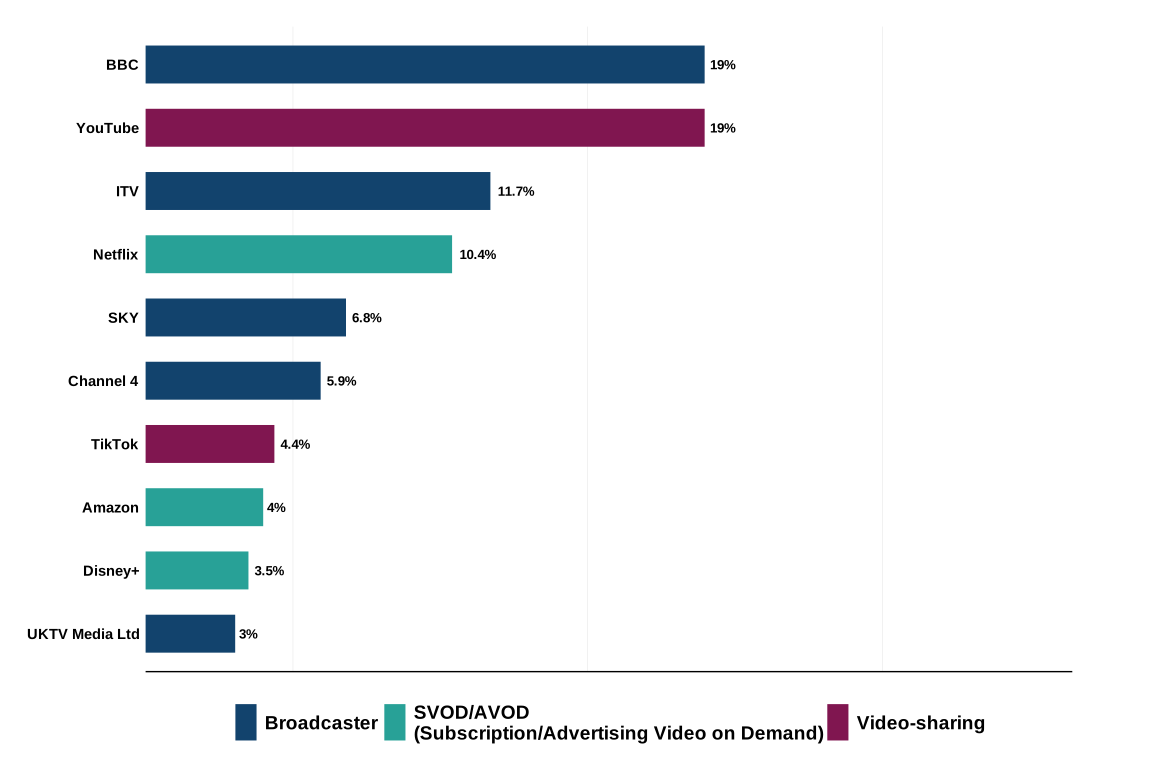
| Platform | Category | Share (%) |
|---|---|---|
| BBC | Broadcaster | 19 |
| YouTube | Video-sharing | 19 |
| ITV | Broadcaster | 11.7 |
| Netflix | SVOD/AVOD | 10.4 |
| SKY | Broadcaster | 6.8 |
| Channel 4 | Broadcaster | 5.9 |
| TikTok | Video-sharing | 4.4 |
| Amazon | SVOD/AVOD | 4 |
| Disney+ | SVOD/AVOD | 3.5 |
| UKTV Media Ltd | Broadcaster | 3 |
Source: DCMS analysis of BARB viewing data
Long gone are the days when the only way of watching TV meant sitting down for a 30 or 60 minute programme in front of a TV set. Today’s audiences want to find content that they connect with, in whatever form that takes and wherever that may be. They are moving away from live broadcast TV, in favour of more flexible and accessible ways of watching video content (see Figure 2). This is particularly the case for younger audiences whose consumption of live TV is now dwarfed by the amount of time they spend watching content on video-on-demand services, streaming platforms or video sharing platforms. In 2024, video sharing platforms and streaming services accounted for 74% of all in-home video time for audiences aged 16 to 24, and 69% for the 25 to 34 cohort. This is compared to 9% and 12% respectively for all live TV.[footnote 4]
Figure 2: The shift from linear to on-demand and social across all ages
Percentage of total identified viewing by category: Quarter 3 2022 compared with Quarter 3 2025
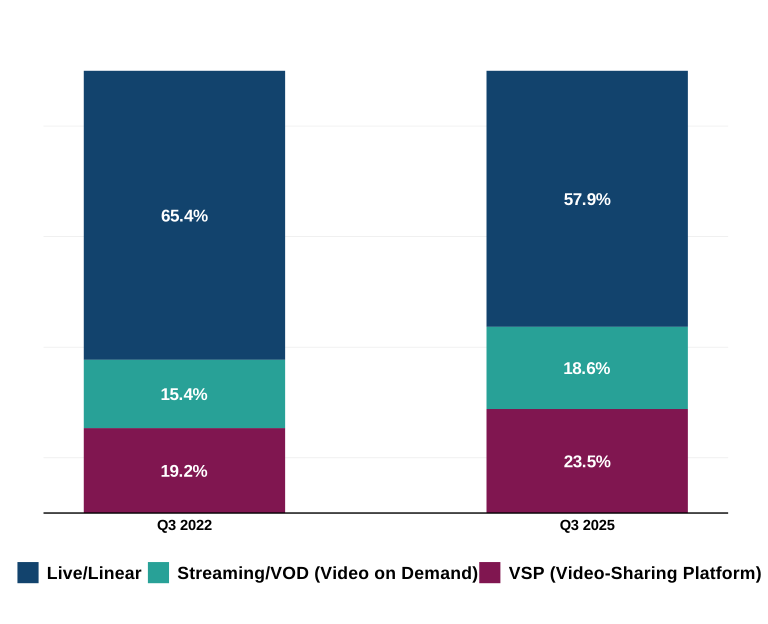
Percentage of Total Identified Viewing by Category: Q3 2022 vs. Q3 2025
| Category | Quarter 3 2022 Share | Quarter 3 2025 Share |
|---|---|---|
| Live/Linear (Including BVOD) | 65.4% | 57.9% |
| Streaming/VOD | 15.4% | 18.6% |
| VSP | 19.2% | 23.5% |
Source: DCMS analysis of BARB viewing data
The lines between TV programming and other internet-delivered video content are becoming increasingly blurred. Social media companies and video sharing platforms are seeking to capture the ‘lean back’ viewing experience of traditional TV with longer, more heavily produced content that is watched on TV sets and that could be considered TV-like. The genre mix of content on these platforms is also changing, away from genres like music, and towards entertainment which was traditionally the domain of large studios and broadcasters.[footnote 5] In February 2025, YouTube’s CEO Neil Mohan declared that “YouTube is the new television”, recognising how it is becoming increasingly common for audiences to watch the platform’s content on their TV sets.
This all means that the way we think about and define ‘television’ is changing before our eyes, which has implications for how the government supports and regulates the TV sector. Broadcasters are no longer competing primarily with each other, but with global technology platforms with significant resources. Without change, regulation, such as the content standards that protect us from harm and ensure news is presented with due impartiality and due accuracy, could struggle to keep up with the varied ways that people are choosing to access content.
Changing audience viewing habits, and particularly the increasing popularity of video sharing platforms and social media, has had profound implications for how and what content is delivered to audiences. Increasingly, decisions about what content people see on screen are not being taken by teams of people working as editors or commissioners, but by algorithms. These algorithms are hugely sophisticated and help people discover content that they want to engage with, and that meets their needs and interests more efficiently than ever before. By the same token, they are also an incredibly powerful tool for helping creators find audiences for their content. Critically, audiences will largely be unaware if the content they are watching is subject to a regulatory regime designed to protect them and uphold quality and editorial standards.
However, most, if not all, of these same algorithms are designed to prioritise content that keeps users on a platform, for example content that triggers strong emotional responses. They encourage engagement over accuracy, and are designed to show viewers more of what they know they like, so they are less likely to expose audiences to content that challenges their existing views. This risks reinforcing biases through individual filter bubbles and echo chambers.[footnote 6]
The consumption of content in individually-curated feeds is eroding the shared cultural and societal experiences associated with traditional broadcasting, which have supported social cohesion. Television still has the power to bring people together, from different backgrounds, from different generations, but those moments are becoming less common.
For children in particular, viewing has moved away from linear TV and towards online and on-demand, where algorithms and personalisation play a fundamental role in what content is surfaced to them. YouTube is now the most-watched service for children aged 4 to 15, accounting for 28% of in-home video viewing for this age group.[footnote 7] While this has provided significant advances in consumer choice and convenience, much of the content will be optimised for a global audience. Content that is made in the UK, and culturally relevant to a UK audience, may not always be prominently featured.
Research undertaken by Ofcom suggests that some children’s content, particularly that which can be found on video sharing platforms and social media, has become faster paced, highly edited, chaotic, and often delivered to the user without context, which can lead to viewers feeling overstimulated.[footnote 8] AI-generated content, which can often lack narrative structure and contain incorrect or misleading information, is increasingly prevalent on social media and video sharing platforms, and is often targeted towards children and younger viewers.
On 15 June, the government made a crucial move to protect children online by banning social media platforms for under 16s. The ban will include platforms like Snapchat, TikTok, YouTube, Instagram, Facebook and X. There will be limited exemptions for some platforms which do not have harmful features, such as YouTube Kids or other educational services. Beyond this there will be restrictions on harmful functions such as live-streaming and stranger communication. Restrictions on these functionalities will also be on by default for under 16 year olds and 17 year olds to prevent a cliff-edge at age 16. The government will also be looking in more detail at overnight curfews and breaks in infinite scrolling for under 18 year olds and will set out more detail in July.
TV has always provided a safe space for children. At its best, high-quality children’s TV and video content helps children learn about the world around them, expand their horizons, and see themselves and their communities reflected back at them. It is essential that children can continue to have access to high-quality, culturally relevant, UK-made content.
1.2. Evolving information environment
With audiences increasingly accessing news online, the boundaries between previously distinct news media are being blurred. TV news, press and audio, often in the form of podcasts, all sit alongside each other online. While the UK continues to benefit from a strong media sector, declining trust, changing consumption habits and the growth of digital platforms are weakening the ability of trustworthy news providers to reach audiences and shape informed public debate.
We must harness our UK news and media sector to produce quality content, given its effectiveness relies on public trust. Since 2018, overall trust in UK news has dropped seven percentage points to 35% and trustworthy media outlets are now part of a fragmented information ecosystem driven by changes in content consumption.[footnote 9] More than half of UK adults (16 plus) now include social media as one of the ways they get their news. This includes accessing headlines or summaries rather than directly visiting news publishers’ websites. This percentage rises to 75% for 16 to 24 year olds.[footnote 10] Media providers are increasingly reliant on these platforms which optimise for engagement rather than accuracy.[footnote 11]
At the same time, new creator-led distribution models, including subscription newsletters and video platforms, are enabling individual journalists and commentators to reach audiences directly. As platforms like Substack expand into audio and video streaming, they are further blurring the boundaries between publishers, broadcasters and user-generated content on video sharing platforms. While this has expanded the diversity of voices online, it has also increased the complexity of the information people see, in which established news organisations sit alongside a growing range of independent commentators.
Despite higher levels of trust in traditional news platforms such as TV, radio and print, online news consumption overtook linear TV for the first time in 2025.[footnote 12] Half of all individuals watch news on any of the main PSM providers each week, a 15 percentage point drop since 2018, and four of the top ten news sources are now social media platforms.[footnote 13] PSM providers are cornerstone sources of trusted news, and their erosion risks creating a vacuum that misinformation and disinformation will fill.
Technological changes are also shifting how news is consumed, and impacting peoples’ ability to find accurate news. The advent of AI assistants and search overviews, which serve as information gateways, have been found to misrepresent news content 45% of the time, regardless of region, language or platform.[footnote 14] Over two-fifths of UK adults already say they encounter misinformation or ‘deepfakes’ and only 45% of adults feel confident judging whether a source of information is truthful or not.[footnote 15] The rapid creation and dissemination of ‘deepfakes’ threatens to erode trust in traditional media brands, risking audiences questioning the authenticity of all audio-visual content, including genuine news reports.
In this new information environment, it is challenging for audiences to tell the difference between news and polemic, and misleading or false content. This green paper seeks to explore how the news and media sector can support the resilience of the UK’s information environment. We want to harness the strengths of our public service media, and work collaboratively across the whole sector to build trust, strengthen media literacy, and guarantee access to accurate news for all audiences, including at the local level. The work the government takes forward to address problems associated with the online news environment will align with our broader work supporting trusted and accurate news, including our Local Media Action Plan.
1.3. How the TV sector is responding
The blurring of boundaries between different sorts of video content is having profound implications for the companies and people that make that content. Broadcasters, streamers and other content creators are operating in an increasingly fragmented and competitive market, which rewards formats and IP that can be adapted across multiple platforms.
Even prior to the explosion of video being consumed on social media, the TV and streaming sectors were dramatically increasing their spending in response to increased demand from audiences for high-end TV content. This began in the early 2010s and peaked in a period referred to as the ‘streaming wars’ in the years immediately before and after the COVID-19 pandemic. This period was characterised by streamers’ debt-fuelled investment in exclusive content. While this was a global trend, the effects were felt keenly in the UK, and particularly by our globally-renowned production sector. At its height in 2022, the UK’s independent production sector generated their highest revenues on record, reaching nearly £4 billion, driven by record levels of international investment.[footnote 16]
However, we have since seen a correction in the market. Content inflation costs have proved unsustainable, and in response to higher interest rates and decreased consumer willingness to pay for multiple subscriptions, the sector has moved to prioritise profitability, and to protect their market positions. Broadcasters, streamers, studios and producers have all sought to diversify their revenues, cut costs and make consolidation plays. For example, many major broadcasters in the UK and Europe have already launched strategies to rationalise their costs, often involving significant job cuts. Scale, particularly when it supports access to data, is increasingly important as competition for advertising revenues intensifies, and to take advantage of opportunities for more targeted advertising and personalisation that command a premium in the market. This has also led to price rises for consumers who do continue their subscriptions. Most subscription streaming services increased their real terms prices between 2020 and 2025.[footnote 17]
Global trends: consolidation and partnerships in the TV sector
Consolidation has been one of the key trends in the TV sector in recent years, with significant mergers and acquisitions playing out in markets across the globe. In August 2025 Skydance Media bought Paramount, one of the oldest studios in the US, for $8 billion. More recently, Warner Brothers Discovery has been subject to takeover bids from Netflix and Paramount, with the latter agreeing a takeover that is still subject to regulatory approvals. In Europe, the Italian-owned company MediaForEurope is seeking to create a pan-European media group, taking control of Germany’s ProSiebenSat.1, and following this up by taking an initial stake in Portuguese media conglomerate Impresa. The UK, which has a relatively unique broadcasting landscape with multiple commercial PSM providers operating alongside commercial broadcasters and streamers, has not yet seen the same level of deal making. However it is still subject to the same market pressures, and public reporting suggests that similar developments could follow in the near future.
Broadcasters and streamers are also engaging in partnerships to increase reach and manage distribution costs. In June 2025, Netflix announced a partnership with the French broadcaster TF1, to enable audiences to watch TF1 channels and on-demand content directly on the streaming platform. Shortly afterwards, ITV and Disney announced a strategic partnership to carry each other’s content on their streaming services, with the deal expanded to include ITV flagship linear channel ITV1 in February 2026.
We committed in the Creative Industries Sector Plan to ask the CMA, supported by Ofcom, to set out how changes in the sector, such as the convergence of broadcast, on-demand and video sharing, could be taken into account as part of any future assessment of the television and advertising markets. The resulting correspondence between the Minister for Creative Industries, Media and Arts and the Chief Executives of the CMA and Ofcom was published on 26 January 2026.
At the same time, other parts of the sector are still expanding rapidly, taking advantage of new technology and opportunities to go direct to consumers. Digital-first start ups are injecting new talent and energy into the sector, while the popularity of influencer videos from content creators in the UK is increasing with both younger and older audiences. Lower barriers to entry associated with new distribution platforms are enabling niche voices, independent journalists, and marginalised communities to find audiences for their content at a scale that previously would not have been possible, including internationally.[footnote 18] The UK media company Goalhanger, known for its series of ‘The Rest Is’ shows, including The Rest Is History, is expanding into the US and other global markets.
These changes have also impacted the content that the sector is making. Increasingly content is not being created for a single distribution channel, but rather to be adapted across multiple platforms to reach fragmented audiences and maximise revenues. This content is also making use of traditional TV talent alongside the most popular stars of the creator economy. The BBC’s hugely successful series The Traitors is an excellent example of this. Episode clips and other short form content are used on social media to drive awareness and build excitement, while a visual companion podcast, the Traitors Uncloaked, deepens audience engagement for viewers who want more than the main episodes. By the same token the companies creating this content are becoming more cross-media rather than focussing on particular distribution channels (this trend is explored further in section 1.5). This cross disciplinary, cross platform, cross format content further underlines the need to look at our approach to the sector.
The Creative Industries Sector Plan is this government’s blueprint for supporting the UK screen sector’s growth and driving inward investment in response to these shifts. Building on our wider creative industries strategy, we are going further with a dedicated plan to make the UK the best place in the world to create film and TV content. This means fostering the right conditions across the country for a thriving, mixed ecosystem, of public service and commercial providers, that attracts inward investment from major international players, sustains a vibrant production sector, and enables UK companies to scale up and retain the value of their IP.
1.4. The impact on the UK’s PSM providers
The UK’s system of public service media is unique, and revered around the world. Six broadcasters, BBC, ITV, STV, Channel 4, 5 and S4C, of different sizes, specialisms and business models, work together, and compete, to bring significant benefits to the cultural, economic and democratic life of the UK. They sit at the heart of our film and TV mixed ecology but this position is under threat as audiences increasingly move online.
First and foremost, PSM providers make high-quality, original UK content, which enables people and communities in every part of the country to see themselves reflected on screen as part of our national story. Public service content from our PSM providers (PSM content) delivers significant social and democratic benefits.[footnote 19] Whether it is the BBC and ITV championing disability representation and highlighting experiences of deafness in Reunion and Code of Silence, or 5 reviving Play for Today and spotlighting such subjects as older relationships and workplace pressures in the education system. ITV’s Mr Bates vs The Post Office helped catalyse public and political opinion on a miscarriage of justice that had been reported on in the press for over a decade, with a direct impact on proceedings in Parliament and the courts.
PSM providers deliver a range of trusted and editorially robust national, international and regional news. Ofcom research has also shown that users of news from PSM providers are more likely to correctly identify important factual information, have higher levels of trust in institutions, and be less polarised than those who do not get news from PSM providers.[footnote 20] They also play a vital role as UK soft power and cultural assets, by projecting British values overseas and driving favourable impressions of the UK. The BBC is the country’s most recognised cultural export internationally, and the BBC World Service remains the world’s most trusted international broadcaster.
At the same time PSM providers are central to driving growth and investment into the sector. Their importance lies not only in their scale, but also in the levels of trust and reliable pipeline of commissioning they bring. These are characteristics that are vital to securing stable and long-term investment, which matters more than ever as the media environment becomes more fragmented and complex. As a result they support the development of the UK’s outstanding pipeline of talent both on and off screen that has helped attract inward investment. The range of content they produce means they can take risks with new and emerging talent. It is the case that without the catalyst and investment in production from our PSM providers, much of the streamers’ production output in the UK may not have occurred.
They also play an integral role in driving growth outside of London and the South East and supporting independent producers based in the nations and regions of the UK. In 2024, primary commissioning spend in the nations and regions generated £1.16 billion in producer revenues, of which PSM providers’ network commissioning spend accounted for 68%.[footnote 21] This investment and activity has supported the sustainability of well-established screen clusters, such as MediaCity in Salford, or Cardiff which has become an internationally recognised hub for high-end drama production with production company Bad Wolf and the associated Wolf Studios being an anchor in the success of the local sector.
The UK also benefits from a system of commercial local TV services, which broadcast in towns and cities across the country. Since the launch of the first local TV service in 2013, local TV has complemented the offer of the national PSM providers through the provision of local news and content to communities across the UK, and has also proved to be a valuable training ground for new entrants seeking the opportunity to gain experience of working in journalism and television production.
However, the media regulator Ofcom has highlighted that PSM providers are under pressure due to their relative size and resources. They are fighting for their content to be seen and heard in a dynamic and competitive market, where people are watching more content on third party platforms (such as social media or video sharing platforms), rather than broadcasters’ own channels or video-on-demand services. The first five channels on the traditional programme guide are no longer the guaranteed front door for TV viewing that they once were. Today, younger audiences are just as likely to turn to a subscription streaming service when they first turn on the TV as they are to watch a linear channel.[footnote 22] This is increasing their reliance on a new generation of intermediaries and aggregators.
Figure 3: Initial browse destinations, 2020 to 2025
“Now please imagine you’re looking for something to watch. Where do you turn first?”
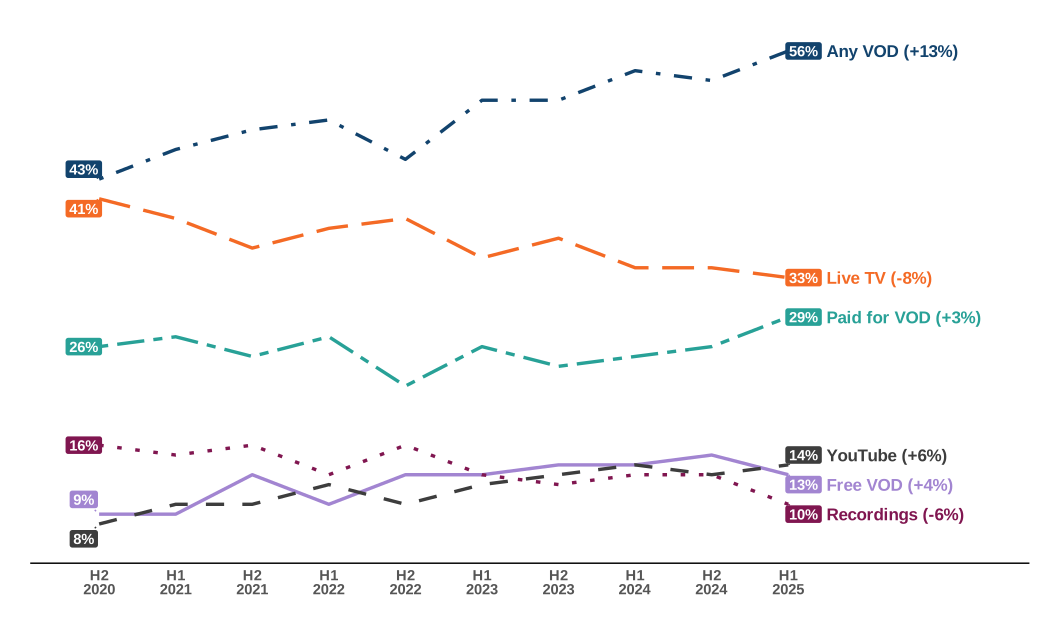
| Destination | 2020 | 2025 | Percentage point change |
|---|---|---|---|
| Any VOD | 43% | 56% | 13.00% |
| Live TV | 41% | 33% | -8.00% |
| Paid for VOD | 26% | 29% | 3.00% |
| YouTube | 8% | 14% | 6.00% |
| Free VOD | 9% | 13% | 4.00% |
| Recordings | 16% | 10% | -6.00% |
Source: MTM 3 Reasons, MTM ScreenThink
PSM providers are starting to make their content available on these services, but the global technology platforms that run these platforms now control the main routes to audiences and shape the economics of distribution. This means it is increasingly difficult for PSM providers to get their distinctive, UK-focused content in front of audiences. It also presents challenges for them to generate sufficient financial returns, making it harder for them to fund the production and distribution of high-quality UK content to all audiences.[footnote 23]
The finances of PSM providers are also coming under pressure from structural changes in the television advertising market. With more competition, combined advertising revenues of the commercial PSM providers (ITV, Channel 4, 5 and STV) was around £1.7 billion in 2024, more than £700 million lower in real terms than in 2018. This trend is being exacerbated by streaming platforms, who previously differentiated themselves from broadcasters by not carrying advertising, launching ad-supported tiers as part of efforts to diversify their revenues and increase profit margins. In 2025 the number of UK streaming subscribers on packages that include advertising overtook those on ad-free tiers.
The BBC is also facing funding pressures, partly due to fewer households holding a TV licence as audiences move away from watching live TV. This has contributed to the BBC’s licence fee income falling by over 30% in real terms over the last decade.[footnote 24] These developments are putting the future of public service media, and the economic, social and democratic benefits PSM providers deliver, at risk.
Figure 4: Revenue from UK TV advertising and revenue from BBC licence fee, 2015 to 2025 (Nominal vs. CPI-Adjusted)
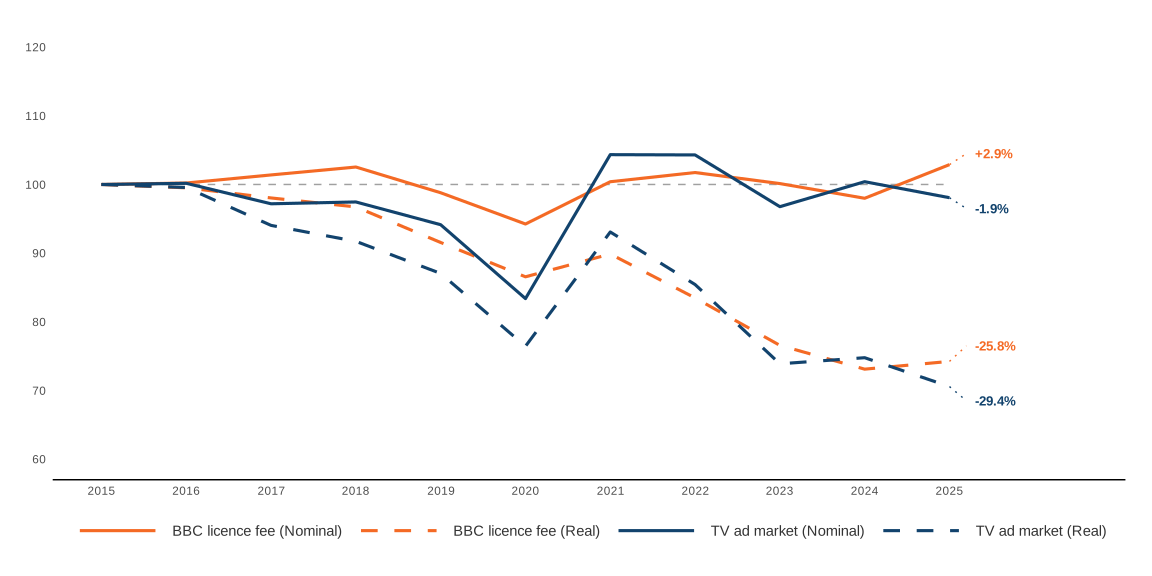
| Metric | Change from 2015 to 2025 |
|---|---|
| BBC licence fee (Nominal) | 2.9% |
| TV ad market (Nominal) | -1.9% |
| BBC licence fee (Real) | -25.8% |
| TV ad market (Real) | -29.4% |
Source: BBC Annual Reports and Accounts, Advertising Association/WARC Expenditure Report, DCMS analysis
There are steps that we encourage PSM providers to be taking already in the face of these challenges. We support Ofcom’s recommendation in their latest review of public service media that PSM providers need to adapt to audience preferences by testing and iterating new ways of distributing and creating content, including on third party platforms.[footnote 25] The government also set out in the Creative Industries Sector Plan that we would support PSM providers’ digital growth and transformation plans, and encourage them to create deep strategic partnerships, where these benefit their financial sustainability and audiences. The changes we are consulting on through this green paper will help PSM providers undertake these activities with increased vigour and ambition. We are also consulting on options through the BBC Charter Review to encourage the BBC to enter into more ambitious partnerships, including collaborating with other PSM providers.
PSM partnerships
There have been a number of examples of ambitious and strategic partnerships involving PSM providers in recent years. The government wants to build a framework for public service media that encourages more of them.
Freely
The BBC, ITV, Channel 4 and 5 collaborated through their joint venture, Everyone TV, to launch Freely, a combined streaming platform. The platform is setting out to future-proof free-to-air television by delivering live linear channels and on-demand content, including high-quality public service content, seamlessly over the internet. This collaboration has since expanded to include STV, S4C and UKTV, alongside global technology partners including Roku and Amazon Fire TV. Adoption of Freely continues to grow and in December 2025 it surpassed one million weekly users.
BBC-S4C partnership
In January 2026, the BBC and S4C announced a new streaming partnership (effective from April 2026) to significantly increase the discoverability of Welsh-language content on BBC iPlayer. Under the agreement, S4C programming will gain high-profile placement on the iPlayer homepage in Wales, while flagship dramas and live sports will be promoted UK-wide for the first time. Beyond improved curation, the partnership introduces enhanced technical features, including multiple live sports streams with optional English commentary and expanded subtitling.
One of the most high-profile ways PSM providers continue to bring the nation together is for great sporting occasions. We want to ensure that key sporting events remain available for people to watch for free for years to come. The Listed Events regime seeks to ensure that audiences are able to watch the ‘crown jewels of sport’for example, Wimbledon or the FA Cup Final, live, without needing to pay a subscription. However, audiences are increasingly choosing to watch sport, on-demand rather than live. The current regime only covers live coverage rights. While live and on-demand rights are routinely sold as a package, we are aware that this will not always be the case. We believe on-demand rights should be protected under the regime, so that PSM providers are able to compete fairly with their larger global competitors for those rights. Therefore, we intend to legislate to extend the regime to include on-demand rights when Parliamentary time allows.
1.5. The impact on the UK’s production sector
Our independent television production sector is a global success story. The UK is renowned the world over for its creative spirit, highly skilled workforce and world-class production facilities. The government continues to support the sector and our Creative Industries Sector Plan sets out a number of commitments, including maintaining competitive tax measures for TV production through the Audio-Visual Expenditure Credit and supporting screen sector skills development to strengthen the workforce.[footnote 26]
Our PSM providers have been central to the strength and success of our independent production sector. They provide a continuity of commissioning activity for independent production companies of all sizes and specialisms. In 2024, PSM providers accounted for just over 80% of domestic UK television commissioning spend.[footnote 27] Domestic TV provides the employment continuity freelancers need to sustain and grow their skills, and acts as a ‘nursery slope’ for emerging writers, directors, crew and producers. This in turn makes the UK attractive for inward investment from streamers and other international commissioners wanting to take advantage of this ecosystem to make content in the UK. In 2025 inward investment productions accounted for £3.3 billion, or 81%, of UK production spend on high-end television.[footnote 28]
Commissioning and production in the nations and regions
From The Responder and Riot Women to Blue Lights and Brassic, these are all stories made outside of London and in screen clusters across the nations and regions (Liverpool, Yorkshire, Belfast and Lancashire, respectively), told by local writers and showcasing the communities in which they are set.
In recent years, efforts have been made to incentivise commissioning and production activity in the nations and regions, including encouraging our PSM providers to establish an increased presence outside of London and the South East (for example, Channel 4 in Leeds and the BBC in MediaCity Salford and Digbeth in Birmingham). However, the television sector remains highly centralised in London and the South East with more than half of primary commissioning spend being made there.
We want to see our screen clusters go from strength to strength and grow sustainably and essential to this is broadcasters and other commissioners being more ambitious in commissioning content across the nations and regions. We have been engaging with industry to understand the barriers to increasing activity and have commissioned research to establish the costs of production activity across the different screen clusters in the UK relative to London and the South East. This will support our next steps in considering how best to support growth of the production sector in the nations and regions.
However, as referenced in section 1.4, the spending power of PSM providers is declining. This, coupled with rising production costs and inflationary pressure in the sector, particularly for high-end content such as drama, is affecting the ability of providers to commission and fund such content at the volume it has previously. In 2024, UK primary commissioning revenues, the majority of which originates from the commissioning spend of PSM providers, declined by 2.3%.[footnote 29]
PSM providers have also begun to adopt digital-first and ‘fewer, bigger and better’ commissioning strategies to prioritise content that performs well on streaming platforms, which in conjunction with shifting audience tastes and habits has resulted in some genres being commissioned less. Pact, the trade body for independent TV and film producers, has cautioned that the combination of the slowdown in commissioning, and the changing mix of genres being commissioned, could be part of a structural change that alters the balance and characteristics of the production sector.
Figure 5: PSM content across genres by number of hours of first-run originated output
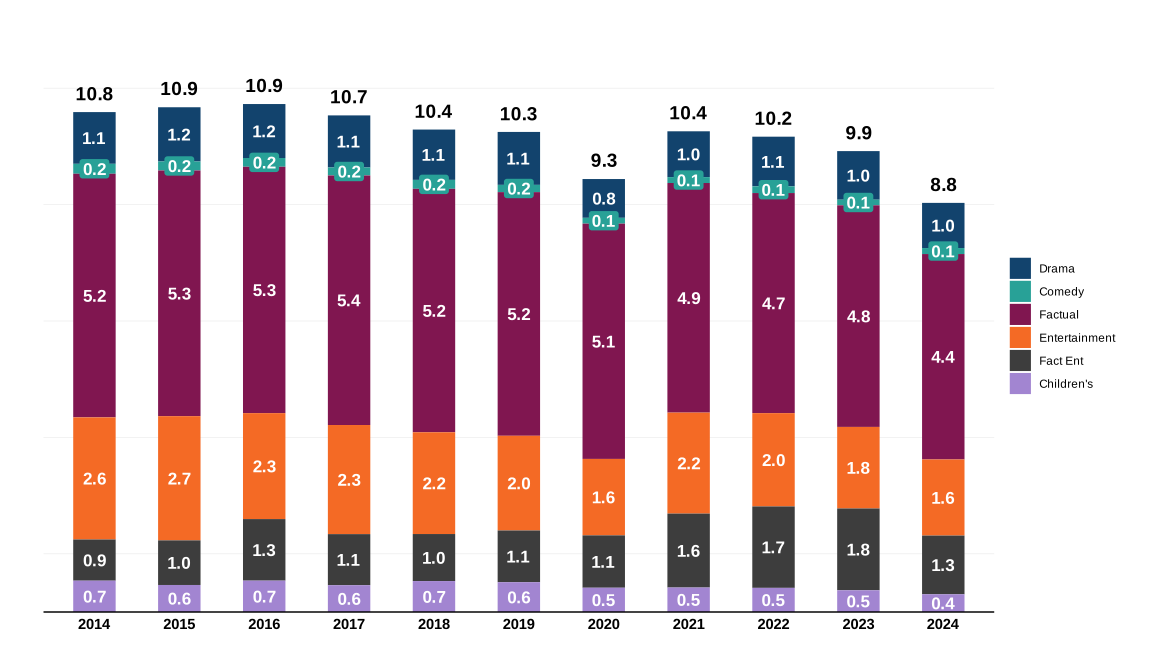
| Year | Drama | Comedy | Factual | Entertainment | Fact Ent | Children’s | Total |
|---|---|---|---|---|---|---|---|
| 2014 | 1.1 | 0.2 | 5.2 | 2.6 | 0.9 | 0.7 | 10.8 |
| 2015 | 1.2 | 0.2 | 5.3 | 2.7 | 1 | 0.6 | 10.9 |
| 2016 | 1.2 | 0.2 | 5.3 | 2.3 | 1.3 | 0.7 | 10.9 |
| 2017 | 1.1 | 0.2 | 5.4 | 2.3 | 1.1 | 0.6 | 10.7 |
| 2018 | 1.1 | 0.2 | 5.2 | 2.2 | 1 | 0.7 | 10.4 |
| 2019 | 1.1 | 0.2 | 5.2 | 2 | 1.1 | 0.6 | 10.3 |
| 2020 | 0.8 | 0.1 | 5.1 | 1.6 | 1.1 | 0.5 | 9.3 |
| 2021 | 1 | 0.1 | 4.9 | 2.2 | 1.6 | 0.5 | 10.4 |
| 2022 | 1.1 | 0.1 | 4.7 | 2 | 1.7 | 0.5 | 10.2 |
| 2023 | 1 | 0.1 | 4.8 | 1.8 | 1.8 | 0.5 | 9.9 |
| 2024 | 1 | 0.1 | 4.4 | 1.6 | 1.3 | 0.4 | 8.8 |
Source: Ofcom, O&O Programme Database, Oliver & Ohlbaum analysis. Chart shows PSM provider first run originated output for all dayparts, by genre, in thousands of hours for 2014 to 2024, excluding news and current affairs and sport.
As competition for commissions has increased, producers, like broadcasters, have turned to consolidation in an attempt to reduce costs and compete with vertically integrated global streaming services. For example, the French production company Mediawan recently acquired the US-based North Road Company in January 2026 with the combined group now having a stake in around 100 individual production companies. The largest production companies are now bigger than many of our domestic broadcasters.
Under the UK’s terms of trade framework, independent producers commissioned by PSM providers retain ownership of their IP, allowing them to build asset value through international sales, format licensing and secondary exploitation. We understand the importance of protecting a vibrant and dynamic production market and the role the terms of trade regime plays in supporting this. It is also important that we have strong and sustainable PSM providers to ensure the framework’s continued success. Reforms introduced in the Media Act 2024 have necessitated PSM providers to update their codes for commissioning from independent producers, and Ofcom’s guidance for PSM providers in drawing up those codes. As a result the government is minded to allow time for these changes to settle before considering whether further reforms would be appropriate.
When global streaming platforms commission directly, they typically retain the IP. Although this has helped fill gaps in domestic production expenditure and generated wider spillover benefits, inward investment increasingly shifts the residual commercial value offshore. While 74% of screen-based businesses actively use some form of external finance (a higher rate than UK SMEs) 83% report unmet finance demand and 77% feel underfunded. The sector faces a core challenge, balancing inward investment with a domestic commissioning and IP ecosystem capable of serving UK audiences. Producers must navigate immediate pressures for production finance amid a volatile domestic market while safeguarding the longer‑term economic value associated with retaining IP.
In response to these pressures, and to help the sector capitalise on growth opportunities in an evolving market, the Creative Industries Sector Plan sets out a coordinated strategy to strengthen the UK’s production landscape. A core priority is expanding alternative financing routes and export opportunities for UK producers, recognising that ‘a mixed film and television ecology’ underpins a strong and internationally competitive industry. Better access to finance will put UK producers in a stronger position to retain their IP, needing to rely less on selling that IP to secure financing and thereby ensuring that they can generate more long term revenue and grow successful businesses.
The plan also includes major investments in talent, innovation, and regional capacity. A £75 million Screen Growth Package launched in April 2026, incorporating an expanded UK Global Screen Fund of £18 million per year (2026 to 2029), to strengthen international business development, support co‑productions and enhance the global distribution of independent UK content. As part of the Sector Plan’s commitment to build a resilient and skilled workforce for the future, the creative industries have committed to tackling bullying, harassment and discrimination through cross-industry support for the Creative Industries Independent Standards Authority (CIISA), which will support the TV industry in its first wave of operations. This is alongside the critical role played by the unions such as Equity and Bectu.
At the same time, changing audience viewing habits, and the growth of video sharing platforms in particular, are opening up new opportunities for producers and other content creators who can build relationships directly with audiences. New platforms enable producers and rightsholders to bypass traditional gatekeepers (such as broadcasters and streamers) and monetise content directly. Demand for new formats like YouTube originals and video podcasts are only likely to increase, and the dynamic and entrepreneurial production companies that make up the UK sector are well placed to benefit.
1.6. Looking to the future
The UK’s media landscape is undergoing its most significant transformation since the invention of television. As audiences move away from traditional linear broadcasting toward an online world, the government is committed to ensuring that our world-leading TV sector remains a cornerstone of our democracy.
Beyond the Media Act
The interventions being consulted on in this green paper build on the important reforms introduced by the Media Act 2024, which support the long term success and sustainability of the TV sector and our public sector media in particular.
The act made much needed changes to the regulation of public service media, which was last substantively updated in 2003. For example, it updates the public service media framework to allow our PSM providers to deliver more of their requirements using their on-demand services (for example, ITVX or S4C’s Clic app). The act also creates a new online prominence framework to ensure that valuable PSM content remains easy to discover on smart TVs. It also brings the regulation of mainstream video-on-demand services more in line with broadcast television, to better protect audiences and help ensure a level playing field.
The process of bringing the provisions of the Media Act into force is well under way. However, the government has committed to ensuring the regulatory framework that our PSM providers operate in keeps pace with changes in the media landscape. The Media Act began this journey, but we’re aware that the sheer rate of change means we now need to consider where we need to go further.
As discussed in section 1.4, PSM providers are now making content not only for their own video-on-demand services, but also for third party platforms like video sharing platforms and social media. In general, this is a welcome development which helps broaden access to high-quality public service content. However, the varied ways that PSM providers are making their content available makes it increasingly impractical for those providers to be regulated primarily through their broadcast licences (this is discussed further in section 4.2). It also raises questions about the scope of the prominence regime, which Ofcom has suggested could be extended to cover those third party platforms, like YouTube (which is considered further in section 4.1).
The reforms in the Media Act did not extend to PSM providers’ news and current affairs quotas which must still be delivered through their broadcast channels. As set out in section 2.1, people are increasingly consuming news online, and this could limit the incentives for PSM providers to provide impartial and accurate news for those platforms.
There is also a risk that, despite the changes introduced by the Media Act, television regulation struggles to keep pace with media innovation and changes to how audiences consume content (section 1.1). The pace of change in this area, even since the Media Act was passed, means it is necessary to look at a new framework for television regulation.
We cannot afford to wait before considering what further changes could be required in the future. Interventions that require legislation may take years to bring about, so it is right that we start consulting on those now.
As the developments in this chapter have shown, we are at a point of transformation rather than evolution. This requires an ambitious approach to policy development. To do this we will take an audience-focused approach, informed by what people consider to be TV or TV-like. The traditional definitions and silos that have prevailed in the sector have broken down, and the government’s approach to support and regulation must respond accordingly, so that we are serving audiences by meeting them where they are going to find content. The main players in the UK TV industry are no longer only domestic broadcasters, but also US studios, international streamers, and social media and technology platforms. This means that we will need to consider how new TV specific regulation works alongside other interventions designed to respond to changes in rapidly changing consumer markets, such as the digital markets competition and online harms regimes, to ensure a coherent regulatory approach.
However, if we can harness this change the potential benefits are huge. Total advertising and subscription revenues are strong, driving growth in overall content investment. Global content spend is forecast to exceed $250 billion in 2026, the highest figure on record. Audiences remain as interested as ever in content, with the latest figures from Ofcom showing that the average UK adult still spends 4 hours and 30 minutes every day watching video content in their homes.[footnote 30] Alongside this, advances in technology mean distribution costs have collapsed, lowering the barriers to entry for swathes of new talent, often from backgrounds that have been unrepresented or marginalised in the past.
Our vision is to transition from a legacy broadcast environment to a modern, internet-led ecosystem where high-quality UK content is not only preserved but thrives. We want to bridge the gap between traditional TV standards and the online world, ensuring viewers seeking out TV or TV-like content are shielded from harmful content and misinformation. We will create an environment where news that is held to high standards of due impartiality and accuracy is easy for audiences to find. We want children and young audiences to explore content that informs and educates, without the risks associated with uncurated platforms. At the same time, we want to make sure that broadcasters are not burdened with outdated regulation which inhibits their ability to grow.
By reforming the regulatory framework for public service media, we will ensure that its social and democratic benefits, bringing people together through shared experiences and trusted national stories, are secured for the next generation. By providing long-term certainty for PSM providers and commercial broadcasters, we will create a landscape that rewards bold, original UK storytelling, and that the best of British television remains a shared and accessible part of our national identity. This vision supports a diverse production sector that spans the entire country, from established hubs to emerging regional clusters. A place where commissioners and a new generation of producers can collaborate, leveraging new technologies to reach audiences in creative ways, while ensuring that the IP and economic benefits remain rooted in the UK.
Chapter 2: Supporting a healthy information environment
The way we consume news and other media has changed forever, creating a critical turning point in our society. The digital age, shaped by algorithms, social media, and the emerging capabilities of generative AI, has transformed how people access news and information. While offering unprecedented access to information, this shift has also made it easier for inaccurate or manipulated material to circulate at scale. The very definition of what is ‘news’ is being challenged. This jeopardises public trust in institutions and threatens access to the truth when we need it most.
A strong, trusted media and information ecosystem underpins a healthy democracy. The democratic role of the media rests on its ability to provide reliable and accessible information, ensuring that diverse perspectives can be heard. Citizens cannot easily make free and informed choices without a media based on shared and accurate facts.
In this context, information is part of our democratic infrastructure. We need to protect our media ecosystem just as diligently as we do other forms of public infrastructure. The goal is not to promote a single narrative or limit disagreement. A plural media environment establishes a shared foundation of verified facts, enabling diverse viewpoints to be challenged and debated. In an environment flooded with misinformation and deliberate manipulation, the value of journalism grounded in professional standards and ethics becomes even more important. The public benefit of such journalism depends both on its accessibility and on the public’s ability to engage with it critically.
There is also significant concern that the distinction between factual news reporting and political polemic is being blurred in the UK media landscape. Whilst partisan reporting has an important place in the information environment, it can be harmful if audiences cannot easily distinguish between objective fact, and opinion or polemic. The rise in politicians being used as presenters has also contributed to this risk, particularly in a regulated and trusted environment such as Ofcom regulated programming.
The integrity of our media and information ecosystem is a national priority that demands urgent consideration to ensure that it keeps pace with the speed of digital transformation. To safeguard an informed democracy and cohesive society, we must tackle these threats with interventions to support a media ecosystem that is independent, accountable, plural and, crucially, trustworthy.
2.1. How technology is reshaping news and information
Recent technological developments pose both opportunities and challenges when it comes to ensuring an informed society and a trusted media environment. Online intermediaries such as search engines, news aggregators and social media, increasingly dominate how people access news online. Indeed, according to Ofcom, 6 in 10 adults use some form of online intermediary (such as social media, search engine or news aggregator) for their news.[footnote 31] In some cases, algorithms prioritise user engagement and popularity over promoting accurate or trustworthy content. Social media platforms also often present professional and user-generated content side by side, masking differences in quality and eroding news brand identity. This intermediation has made it harder for even well-intentioned people to understand, assess and contextualise the information they are presented with, which underlines the importance of media literacy.
It also makes it more difficult for trustworthy news providers to find, maintain and monetise an audience, with repercussions for the commercial viability of public interest journalism. The CMA’s new digital markets regime will help address this issue, by boosting competition and helping rebalance the relationship between major platforms and those who rely on them, including news providers. The CMA recently imposed the first Conduct Requirement under the regime on publisher controls in Google search and search advertising, aiming to ensure transparency, attribution and choice for publishers in how their content, collected for search, is used in Google’s AI features in search, such as AI Overviews.
More broadly, the recent rise of generative AI exacerbates these challenges because it makes it even more difficult for people to understand whether information is trustworthy or not, as well as accelerating commercial challenges. This makes the case for intervention more urgent than ever. Generative AI also poses huge opportunities in the production, distribution and consumption of news and information, but we also need to be mindful of the potential threat it poses to trust in the media environment. AI-generated news summaries also intermediate the relationship between news providers and audiences, but do so by seeking to fulfil the audience’s information needs rather than simply to facilitate access to the news provider’s own service, thereby further eroding newsbrand identity, audience traffic and consumer-derived revenue. This mediation is particularly concerning given the potential for inaccuracy. Recent research by the BBC found that 51% of all AI answers to questions about the news were judged to have had significant issues, and 19% of AI answers citing BBC content introduced factual errors.[footnote 32]
Case study: AI labelling
Steps are already being taken to help users online distinguish synthetic content. TikTok now automatically labels inbound media when metadata is attached to it; YouTube has started to use labels underneath videos that indicate whether it was filmed on a camera; Meta use metadata to inform their ‘Made with AI’ labels on Instagram and Facebook; and LinkedIn displays Content Credentials on supported images and videos.
The BBC is also developing an approach to labelling AI content that is ‘rooted in audience needs, designed to work across all our products, and focused on two main things: transparency and trust.’ However, we know more needs to be done and that is why the government is establishing a taskforce to put forward proposals to government on best practice for labelling AI-generated content, with an interim report to be published in the autumn.
Indeed, the rise of ‘deepfakes’, AI-generated videos, images, or audio recordings that make it appear as though a person is saying or doing something they never did, also pose a threat to our information environment. It is already becoming harder than ever for audiences to judge whether a piece of content is real or not, raising concerns about a broader erosion of trust in all audio and audio-visual content. This will worsen as more powerful AI tools are rolled out. The government will launch a consultation on digital replicas in the summer. This will seek views on how to address the harms caused when someone’s likeness is replicated without their permission, while protecting legitimate innovation.
The media industry has certain tools at its disposal to verify the authenticity of its sources. Provenance standards such as C2PA Content Credentials are being developed that embed metadata into images, videos and audio to show when, where and how content was created. This helps journalists and users online to understand where a piece of content has come from.
However, as ‘deepfakes’ and other types of synthetic media become increasingly sophisticated and harder to detect, we will explore whether we can support the sector to integrate new detection technologies and ways of working.
The rise of social media and AI for news has deep implications for society and our media ecosystem. There are three key areas where the government could support the media sector to tackle these challenges:
- Continuing to support research and development (R&D) efforts, such as the Home Office-led Deepfake Detection Challenge, to find the best detection tools, and work to ensure these can be rolled out across the wider media industry including smaller news media organisations.
- Exploring the feasibility of technical solutions, such as provenance and labelling, for the identification of AI-generated content and to support transparency. These technical measures could enable high-quality media to clearly distinguish itself from misinformation and disinformation online. As part of this, the government is establishing a taskforce to put forward proposals on best practice for labelling AI generated content. .
- Further engagement on technical standards with news media, AI developers, and other relevant stakeholders, including via the AI Labelling Taskforce and through the Digital Replicas Consultation, announced by the government in March 2026.
Alongside government support, sections 2.2 to 2.4 explore interventions to rebalance the information ecosystem to prioritise high-quality, trustworthy news and ensure it is visible and easily discoverable and empower users to engage with content online and offline.
Case study: A new framework for deepfake detection
Bringing together leading technology companies, such as Microsoft, academics and experts, the government is set to develop and implement a world-first deepfake detection evaluation framework, establishing consistent standards for assessing all types of detection tools and technologies. This will help position the UK as a global leader in tackling harmful and deceptive deepfake content.
2.2. Prominence of news on social media
The UK’s media landscape consists of a diverse array of news providers, encompassing PSM providers alongside a wide range of national, regional, and local news organisations. While PSM providers operate under independent Ofcom regulation for due impartiality and accuracy, the wider traditional news media ecosystem is self-regulatory, underpinned by codes of practice, which govern professional and editorial standards and are, in many cases, overseen by independently established regulators. Trustworthy and reliable news, and the providers that deliver this, is essential to our democratic foundations, ensuring a comprehensive breadth of coverage that reflects the lives and concerns of communities across every nation and region of the UK.
News consumption increasingly takes place online, and often via social media platforms. This delivers benefits in terms of the variety of news available, especially to international news sources, but also means algorithms on social media platforms like Meta platforms have a significant role in determining what audiences see and that high-quality, reliable or regulated news may not be easy to find.
In this context there is a risk that less accurate sources of news and information displace more trustworthy news sources. In 2024, 43% of people said they encountered some form of misinformation or ‘deepfakes’. 71% of those who were exposed to misinformation said this was online (including websites and social media).[footnote 33] While lots of users encounter misleading content, a third of UK adults say they are not confident in their ability to identify AI-generated material.[footnote 34] Furthermore, a recent study suggests that people’s confidence in spotting AI-generated material is often higher than their actual ability.
A lack of consistent access to reliable, trustworthy information can pose chronic risks to our democracy, public safety, and social cohesion. As reflected in the government’s Protecting What Matters policy paper, misinformation and disinformation and online echo chambers can significantly exacerbate polarisation, conflict and division, whilst undermining trust in our most important institutions and making us more vulnerable to hostile and extremist influences.
Ensuring the prominence of trustworthy sources of news and information on the biggest social media platforms is also particularly critical in ensuring resilience during periods of community tension, social unrest and democratic events. With the online information environment being particularly susceptible to misinformation and disinformation during these periods, it is therefore critical that the public is supported to find trusted and accurate information and news. In fact, evidence shows that in times of major news events or local incidents, citizens turn to more traditional forms of news outlets such as the local newspaper, local radio stations or PSM news. While inaccurate information may often be disseminated without malicious intent, malign actors increasingly exploit these times to deploy disinformation campaigns. Trustworthy news is a crucial counter to both this misinformation and disinformation.
For example, between 30 July and 7 August 2024, following the Southport stabbings, a wave of anti-immigration public disorder and riots took place across the UK. Ofcom noted the pivotal role of “algorithmic recommendations” in propagating and amplifying misleading and divisive narratives. These recommendations often push misleading content to large audiences at the expense of authoritative information, accelerating the spread of misinformation and disinformation and in this instance, contributing directly to the escalation of real world violence.
DCMS-commissioned research into the nature of local media coverage of the riots highlighted the role that local media played in de-escalating tensions by amplifying the voices of community leaders, religious leaders and the police, in contrast to more inflammatory content on social media.
The vital role of local media in the fabric of our society, in providing high-quality and relevant local news and information in our communities was highlighted in the government’s Local Media Strategy, and we committed in that strategy to explore the prominence of news content from commercial local media.
The government will therefore explore legislative options to establish a prominence regime specifically for trustworthy news content on social media which is linked to, but distinct to the wider prominence regime for PSM content discussed in section 4.2. This would require social media platforms, as well as potentially video sharing platforms, to ensure news content is prominent and discoverable within user interfaces. This would look to ensure people can access factual, accurate and trustworthy news when online. These measures could include news publishers at national and local level, recognising the importance of citizens’ access to a plural range of voices and ensuring we capture local news and voice.
The government will take forward work in the coming months, alongside industry engagement and assessing consultation responses, to explore what a news-specific prominence regime could look like in practice. The government will shortly conduct research to test various methods for achieving prominence on social media platforms, ensuring that these are proportionate and in keeping with ensuring a diverse and pluralist information landscape. As part of this, the government will adopt the following principles when developing this work and delivering any new prominence measures:
- Audience led: We recognise the need to balance prominence of news content with ensuring user empowerment.
- Future-proofed: Any prominence for news content regime will need to be flexible and variable across platform user experiences and able to evolve with technology and AI advancements.
- Outcomes based: Any new regime will need to be feasible for platforms to implement and any measures should be outcomes-based, giving platforms the flexibility to deliver these outcomes in a proportionate manner. The government will work alongside the sector to ensure this is achieved.
- Comprehensive and relevant: Any measures taken here should ensure that citizens across all parts of the UK have access to news and information which is relevant to them, and we may therefore need to consider, for example, what this means for regional and local news providers compared with national news providers. The right balance will need to be found between the prominence of national news media organisations and local providers, ensuring the right voice and expertise is at the forefront of any prominence measures.
- Plurality of views: We are mindful of the need to ensure that any action only promotes high-quality sources of news, while at the same time not being so prescriptive that we risk exacerbating the commercial challenges faced by many news publishers online or impacting plurality of news.
- Criteria for a ‘trustworthy’ news provider, decided in an open and transparent manner with regard to protecting media freedom. It is key that any process for determining news providers’ prominence is decided in an open and transparent way and subject to necessary checks and balances.
As part of our policy process we need to look at how we develop criteria for a ‘trustworthy news provider’. We have not yet determined what criteria we will use and will want to engage stakeholders, including as part of this consultation, to do this. A starting point for this may be the recognised news publisher definition in the Online Safety Act 2023 which includes both broadcasters and UK based entities whose primary purpose is publishing news-related material, created by different persons, subject to editorial control, a standards code, and with a mechanism for resolving complaints.
The policy process will also want to understand whether the benefit of prominence should be explicitly linked to further responsibilities for news providers in scope of any new regime to ensure that only the most trustworthy news sources benefit from prominence. This could include greater transparency, effective complaints processes, more stringent standards in AI content use, promoting media literacy or adherence to evolving best practices.
Finally, while establishing prominence measures may help support access to reliable news sources, we recognise that they will only be effective in ensuring audiences critically engage with those sources if complemented by efforts to equip audiences with the skills needed to navigate the broader, complex online environment. In this context, options around enhancing audience empowerment through new media literacy interventions are discussed below.
2.3. New media literacy duty for PSM providers
Changes in how news is distributed online mean that many people now encounter information in complex, algorithmically shaped environments. In this context, being media literate is essential. In 2025, Ofcom reported that only 45% of adults felt confident judging whether a source of information is truthful.[footnote 35] This erosion of confidence underlines the scale of the issue and the need for a coordinated response. This matters not only for individual decision making, but for the health of our democracy. Research finds that higher levels of media literacy are associated with greater participation in civic activities.[footnote 36]
We want to strengthen and build on the important work already being done to improve media literacy in the UK. On 16 March 2026, we published the Media Literacy Action Plan, setting out a clear direction and a more joined-up approach across government. Vital work to improve media literacy has already begun. For example, the Department for Education is implementing recommendations from the Curriculum and Assessment Review to help pupils identify misinformation and disinformation, including AI-generated content, and to build critical thinking skills.
PSM providers in the UK have a long and proud tradition of providing impartial and trustworthy news. The BBC has the largest cross-platform news reach in the UK, at 67% of all UK adults, and research shows it is the most trusted news source among those surveyed in the UK.[footnote 37][footnote 38] By delivering impartial content that supports informed debate, PSM providers strengthen social cohesion and democratic participation. They also play a vital role in supporting a healthy information environment, and empowering audiences to critically engage with the content they see. PSM providers already make valuable contributions to media literacy in the UK; for example, the BBC’s existing media literacy programme, Other Side of the Story, reached over 2.4 million young people in 2024.[footnote 39]
Research shows that people are more likely to engage with media literacy support when it is delivered by organisations they trust.[footnote 40] This combination of trust and reach places PSM providers in a strong position to support media literacy across the system, ensuring people have the skills they need to navigate today’s information environment. We will therefore explore the introduction of a potential additional duty on PSM providers to report on media literacy activity.
As our proposals earlier in this chapter set out, there is further action that platforms can take to tackle misinformation and disinformation. The scale and complexity of the modern information environment requires action across the system, and PSM providers should continue to draw on their strengths to support this. Subject to consultation feedback, this duty would require PSM providers to both deliver and report on media literacy activity, setting out their plans via a media literacy strategy, and reporting on the effectiveness of their interventions. Guidance would set out the expected scope and ambition of this activity. Any new legal duty on media literacy must be deliverable within a sustainable public service media ecosystem. This option is therefore being considered within a broader package of reforms designed to ensure PSM providers are on a sustainable footing for the future, and that the PSM compact remains appropriately balanced between any new obligations and the benefits (set out in section 4.2). If prominence and discoverability of PSM providers’ services are strengthened, it is right that these providers hold a responsibility for supporting the public to engage critically with the information they encounter.
2.4. A new joint initiative to promote media literacy
The UK has a rich and active media literacy landscape with multiple stakeholders contributing to activity including government departments, schools, libraries and civil society. Ofcom, as the UK’s communications and Online Safety regulator, has media literacy duties and an established role in supporting media literacy. Ofcom’s current three-year strategy focuses on convening stakeholders, promoting best practice, and strengthening the evidence base on what works for audiences. Ofcom will soon publish its Media Literacy recommendations. The recommendations, required by the Online Safety Act, will set out for the first time Ofcom’s expectations for how broadcasters and online services can best promote media literacy.
Organisations delivering media literacy interventions often have strong sector expertise and can deliver tailored interventions to a variety of needs and contexts. However, provision is geographically dispersed. Organisations often work in silos, reflecting the diversity of actors and approaches across the sector. Despite the breadth of media literacy activity, the 2025 House of Lords media literacy inquiry found that the media literacy sector is highly fragmented.
Many factors shape the public’s ability to make informed decisions and participate in our democracy, including what they learn in school, what they see from broadcasters and news providers, their experiences online, and the guidance they receive from families and communities. We want to support coordinated media literacy activity that is shaped by shared priorities, and complements the role of the education system.
To achieve this, we will explore the development of a new initiative to support coordinated delivery of media literacy activity. Public service media and the wider media sector, both local and national, will be central to this. We will also explore ways to engage a broader range of organisations, including civil society and technology companies, to support a move beyond siloed approaches and towards more joined-up, cross-sector working. We want to support more strategic delivery of media literacy interventions, strengthen partnership working, and enable best practice to be shared more widely across the media literacy ecosystem. Working closely with Ofcom, this could focus on identifying priority areas, building on evidence of what works, and supporting proportionate evaluation.
Any new initiative will align with the principles set out in the Media Literacy Action Plan, and complement rather than duplicate the wider activity already under way across the sector. We will also ensure that this work aligns with the work already being done by Ofcom. We want to maximise the investment being put into media literacy by increasing the impact of collective efforts, for the benefit of both the sector and the public.
Chapter 3: How audiences will continue to access high-quality, trusted television content
Television forms a foundation of our national identity and a vital engine for our democracy, society, culture and economy. In an era of increasing digital fragmentation, television remains one of the few places where the nation comes together to share major cultural moments, from series finales, royal occasions and sporting triumphs to breaking news. It helps to bridge geographical and social divides by providing a common set of facts and a shared window into the lives of others across the UK. Ensuring that every household, regardless of where they live, can continue to access a wide range of high-quality, trusted content including news but also other genres like documentaries and culturally relevant drama is essential for maintaining a sense of belonging and a well-informed society.
For decades, the traditional ‘aerial on the roof’ (digital terrestrial television) has been the primary way we ensure this access is universal. It has provided a public square where the news is held to high standards of accuracy and impartiality, and where UK stories are told with a voice that reflects our own values. As more of us embrace the benefits of watching TV over the internet, we face a significant challenge: how to harness the benefits of new technology without losing the access, cohesion, protections and democratic safeguards that traditional broadcasting provides. If we do not manage this transition carefully, we risk a digital divide where some members of society are left without the shared information and social and cultural connections that help bind us together.
This chapter sets out how the government intends to navigate this shift from traditional broadcasting to internet-based viewing. Our goal is to ensure that the television of the future remains a reliable, accessible, and trusted space that continues to serve the public interest. We must guarantee that even as technology changes, the principles of universality and high standards remain. By doing so, we can ensure that television continues to support a healthy democracy and a cohesive society, providing a trusted and safe platform for debate and a mirror in which all parts of the UK can see themselves reflected.
3.1. The future of TV distribution
This section is supported by a set of annexes. These provide further detail on the policy process to date, our assessment of the key challenges, and a cost–benefit analysis.
Case for change
The UK TV landscape is undergoing a profound shift from traditional broadcast to online linear and on-demand viewing, collectively referred to here as ‘internet protocol television’ (IPTV). Audiences are increasingly accessing content via internet-connected devices, creating a hybrid landscape between IPTV, traditional digital terrestrial television (DTT), satellite broadcasting and cable.[footnote 41]
IPTV
Internet Protocol Television (IPTV) is a way of watching TV using your internet connection instead of traditional digital terrestrial television (DTT), satellite, or aerial signals. Instead of broadcasting all channels at once like regular TV, IPTV sends the specific show or channel you choose directly to your device through the internet. This means you can watch live TV, on-demand films, or recorded programmes on smart TVs, computers, tablets, smartphones, or streaming boxes. Services like Amazon Prime Video or Netflix use similar internet-based technology, but IPTV often also includes live TV channels for free, much like traditional DTT.
DTT
A broadcasting system where television signals are transmitted over the air from land-based transmitters and received by an aerial rather than via cable or satellite - how people receive Freeview.
Freeview
Freeview is a digital terrestrial television (DTT) service that delivers free-to-air TV channels through an aerial. Freeview Play is an enhanced version of Freeview that combines broadcast TV with internet-delivered catch-up and on-demand services.
This shift is delivering greater choice, convenience, and the proliferation of streaming platforms to millions of households. An IPTV-based television system has the potential to enhance the viewing experience for audiences across the UK. It can enable seamless access to live and on-demand content, greater personalisation, improved accessibility features, and the ability to enjoy services across multiple devices.
Being online is no longer a ‘nice to have’. It is increasingly how people access healthcare, manage money, keep in touch with family, apply for jobs, and use public services. People who are not online, or who lack confidence using digital services, are more likely to pay more for everyday essentials, struggle to access support, and feel excluded from parts of modern life. Managed well, supporting people to access television over the internet can open the door to wider digital participation. Once households have a reliable connection and the confidence to use it, they are better placed to:
- book GP appointments or order repeat prescriptions online;
- manage benefits, pensions or council services digitally;
- use online banking safely and conveniently;
- compare energy, broadband or insurance deals and save money;
- access learning, skills and employment opportunities; and
- stay socially connected, reducing loneliness and isolation.
However, the government also recognises that a significant number of audience members continue to rely on traditional broadcast platforms encompassing DTT (Freeview) and satellite, as their only means of accessing television. These platforms remain vital for universal TV access, accounting for 4.01 million broadcast-only households in 2024, alongside 16.61 million ‘hybrid’ homes.[footnote 42] However, overall usage across these traditional methods is declining. The number of households without access to IPTV is projected to fall to 1.51 million in 2034. The number of hybrid homes is also expected to fall as an increasing proportion of households choose to access both live and on-demand services over the internet.
Figure 6: Household IPTV access types (millions)
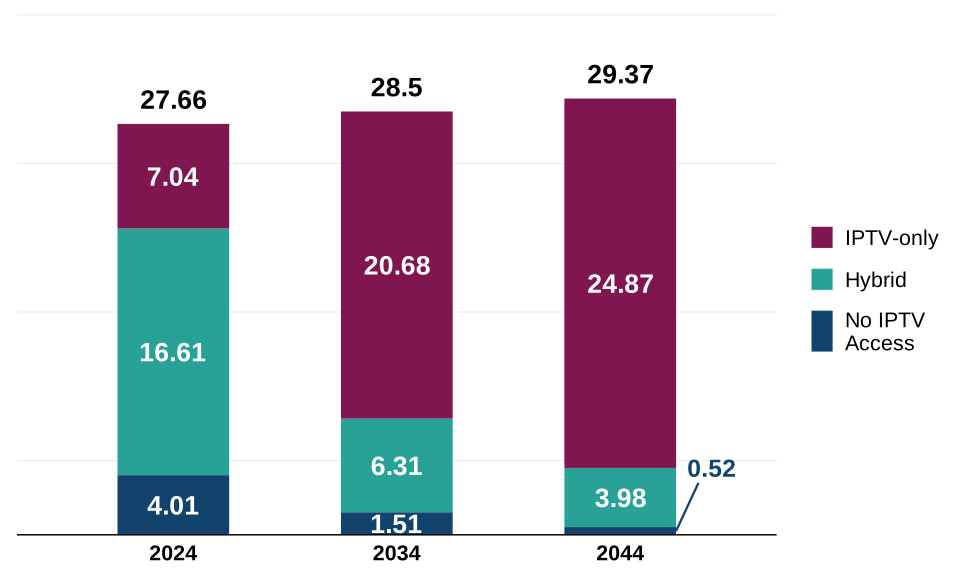
| Category | 2024 | 2034 | 2044 |
|---|---|---|---|
| IPTV-only | 7.04 | 20.68 | 24.87 |
| Hybrid | 16.61 | 6.31 | 3.98 |
| No IPTV Access | 4.01 | 1.51 | 0.52 |
| Total | 27.66 | 28.5 | 29.37 |
Despite this declining usage, the costs of maintaining the DTT network borne by broadcasters, are largely fixed. Maintaining the DTT network beyond 2034 means broadcasters will face the economic challenge of carrying the costs of multiple distribution methods to an ever reducing number of households relying on DTT.[footnote 43] As the number of DTT households falls, the incentive to pay for carriage on the DTT platform will fall, resulting in fewer channels being available and increased costs for remaining providers.[footnote 44] For those broadcasters who remain on the DTT platform, including PSM providers, these increased costs will reduce the amount they can invest in programming and thereby reduce the social and economic value they add.
PSM compact
Under the current ‘PSM compact’, PSM providers are required to ensure universal, free-to-air availability of their services. Their TV channels must be free and available to everyone, especially on traditional TV platforms like Freeview. In return, these broadcasters get benefits such as good channel positions and visibility on TV platforms, which makes it easier for viewers to find them. However, this also means they must keep broadcasting on traditional TV systems and cannot freely choose how their channels are distributed. As more people move to online and streaming services, fewer viewers are using traditional TV. Because of this, the cost of broadcasting on these older systems may become higher than the advertising money they earn, ultimately resulting in the obligations associated with being a PSM provider exceeding the associated benefits.
The government wants all audiences to be able to receive and access the full range of content and services available through IPTV in an affordable and accessible way, ensuring that no one is left behind (detail at Annex B). Ensuring affordability of connectivity, devices, and ongoing use, will be an important factor in supporting broad and timely adoption. Over time, we believe that a coordinated, industry-led effort to support audiences to transition their viewing from DTT to IPTV will support these aims, delivering a more inclusive, accessible and future-proof television ecosystem, one that expands choice and improves quality, allowing the television sector to remain sustainable and continue investing in content that benefits all audiences.
While significant progress is taking place, we recognise there will be challenges for some people in accessing sufficiently fast broadband and having the digital skills to make best use of it. This has the potential to create digital exclusion if DTT services are withdrawn prematurely. Decisions on the long-term future of DTT, and the transition to IPTV, are therefore critical for ensuring we deliver for all audiences, maintain a reliable television service, promote competition and innovation in the television industry and support a sustainable future for PSM providers (more detail at Annex B). The ease of such a change will also depend on the future role of satellite television as an alternative and economic means of TV delivery.
The government is committed to the continuity of DTT until at least 31 December 2034 and a decision on the future of TV distribution beyond this has not yet been made. DCMS has been undertaking work to evaluate the future distribution of television, including by convening the Future of TV Distribution Stakeholder Forum. The next section sets out the initial conclusions from that work and a proposed way forward.
Proposed approach
The government has considered a wide range of potential long-term models for the future of UK television distribution beyond 2034. We have explored options (see Annex A) to identify the best outcome for a sustainable and successful UK television distribution ecosystem in the coming decades.
One thing that has become readily apparent is the significant benefits to households of adopting IPTV services. As outlined above, it provides access to a wider range of high-quality online content, much of which is available at no additional cost. Audiences increasingly expect to watch live and on-demand content seamlessly across devices, with greater choice, flexibility and accessibility. IPTV enables this in ways that traditional broadcast platforms cannot: it supports more personalised and responsive services, improved accessibility features, and new forms of innovation in content discovery and delivery.
Managed well, the transition from traditional broadcast to IP-based television represents one of the most significant opportunities for public service media, audiences and the wider digital economy in a generation. This transition can also act as a gateway to wider digital participation, if the transition is designed inclusively and delivered with the right support.
In respect of the future of DTT services, the diverse interests of broadcasters, network and infrastructure providers and groups representing audiences has meant that a consensus has yet to emerge on the optimum outcome for all of UK society and business on the future of TV distribution. However, there is now emerging stakeholder agreement on a number of key points, including:
1. Viewing habits and technology trends indicate a continued shift from DTT towards IPTV over time. The benefits delivered by IPTV will continue to grow rapidly, as a consequence of further steps taken by broadcasters and others in industry to develop new services, platforms and devices and to market and explain those to consumers. Maintaining the DTT platform will therefore become uneconomic within the next two decades, and potentially as soon as 2034;
2. If (and only if) the costs of carriage on DTT for PSM providers can be reduced to a manageable level, there may be a place for DTT to continue beyond 2034, to make the transition more manageable for audiences (especially those more reliant on DTT). In this circumstance there could be a role for supportive policy or regulatory approaches (see Annex C);
3. Any such continuation will present challenges for broadcasters due to the need to continue to accommodate the DTT distribution costs, in the face of reducing viewer reliance on it, alongside the growing cost of IPTV distribution associated with increasing uptake. So any extension of DTT timescales needs to be affordable to those PSM providers who underpin the infrastructure. Furthermore, PSM providers would be reluctant to bear alone the risks of continuing DTT if demand from commercial DTT services were to decline over an extended period; and
Irrespective of when DTT services cease, the government and industry will need to work together to address a number of key challenges that have already been identified (Annex B). There are also potentially significant knock-on impacts on other users of the high mast distribution infrastructure such as BBC and commercial radio services.
As explored in more detail below, the government’s proposed approach is two-fold.
- First, we will work with industry and audience groups to design a package of support for audiences to transition their viewing to IPTV services and to make the most of the additional benefits this provides. This package will depend on industry and a strong ecosystem working together to develop and deliver it: public service media providers, platform operators, telecoms providers, manufacturers and retailers, charities and local delivery partners, each playing their part.
- Second, we will set out the plan for a managed switch-off of DTT services, either on expiry of current licences on 31 December 2034 or following a time-limited extension to 31 December 2044.
DTT switch-off
A DTT switch-off is about turning off a specific delivery method (terrestrial broadcasting), not about turning off channels themselves. The same channels would continue to exist and remain available through other platforms, such as satellite or internet streaming.
The government is therefore of the view that television distribution will, over time, transition towards IP-based services and this will result in the DTT platform becoming economically unsustainable. The consultation we are undertaking as part of this green paper will support us in determining, on the basis of evidence and stakeholder input, the most suitable timeframe.
To deliver this approach would require continued close and collaborative working with audience groups, industry and across government. With this in mind the government is asking these groups to come together to submit innovative solutions to deliver this transition via the consultation. No assumption should be made at this stage that public funding will be available to support a transition.
An IPTV transition
The transition away from DTT offers a significant opportunity to modernise how television is delivered in the UK, building on strong foundations to create a more flexible and future-ready system. IP-based delivery can enhance viewing experiences, broaden access to content, and support a more dynamic broadcasting landscape, while continuing to bring audiences together through trusted news, major national moments, and high-quality public service content.
Handled well, this shift can support a sustainable model for both audiences and industry. It creates scope to improve accessibility, widen device choice, and make services easier to use across a range of households, while enabling continued investment in UK content and supporting public service media in a digital environment. However, the transition also raises a set of interconnected challenges around delivering for all audiences, maintaining a reliable television service, promoting competition, and supporting the long-term sustainability of PSM providers (more detail at Annex B). In particular, while it may financially benefit PSMs to not have to provide services on DTT, a full transition to IPTV (alongside broader digital distribution) will require significant investment so they are able to deliver products that best serve audiences and which can compete with offerings from international providers.
How IPTV services can improve accessibility and wellbeing
Working with partners including Alzheimer’s Society and Dementia UK, the BBC used BBC iPlayer to curate collections of familiar programmes from its archive, organised by decade, place and shared experiences. These collections were designed to be easy to find and simple to use, and aimed to help people living with dementia recall memories and start conversations with family members and carers.
Evidence from the initiative showed that familiar, on-demand television content can help people feel more confident and settled when watching TV, reduce confusion, and support social interaction. Families and carers reported that being able to personalise content, for example by grouping favourite programmes together, made television easier to use and more enjoyable.
Importantly, these benefits were enabled by IPTV features that traditional broadcast television cannot provide, such as on-demand access and simple personalisation. The initiative demonstrates how, when designed accessibly, IPTV services can improve quality of life and support inclusion, particularly for older people and those with lower digital confidence, rather than making television harder to use.[footnote 45]
A key priority is ensuring that households are not excluded as viewing moves online. This requires widespread availability of reliable broadband connectivity, including superfast speeds for those who currently rely on DTT, alongside affordable pricing structures. Low-cost broadband tariffs and targeted support measures will play an important role in helping lower-income households remain connected. Equal attention should be given to device affordability, with simple, low-cost IPTV equipment, such as smart TVs or adaptors without ongoing fees, that replicates the ease and familiarity of traditional television. This includes straightforward setup, direct access to live channels on start-up, and intuitive navigation via remote controls and electronic programme guides, alongside reliable provision of accessibility features such as subtitles, audio description, and sign language.
Major work is already underway to strengthen the infrastructure foundations needed for IP-based services at scale, including progress toward near-universal access to high-quality broadband. The government, in partnership with industry, is driving gigabit broadband rollout so that 99% of UK premises can access high-quality, futureproofed broadband connectivity by 2032. Alternative technologies are continuing to develop at pace, and the government will continue to monitor and support these developments to help improve connectivity for more remote premises. This provides a strong basis for government and industry to plan for a transition, while focusing collective effort on the smaller cohort of households most likely to need additional support.
Beyond infrastructure and devices, IPTV services should be intuitive and inclusive. This includes simplifying login processes, supporting a wide range of devices through open standards, and designing interfaces that cater to varying levels of digital confidence. Broader digital inclusion will be essential, requiring coordinated efforts across industry, government, local authorities, and community organisations to provide training and practical support. PSM content should remain free at the point of use, maintaining a baseline experience comparable to current DTT services.
Maintaining a reliable television service is also critical. Any replacement for DTT should meet or exceed existing standards, particularly during peak viewing periods and major national events.This will require continued investment in broadband infrastructure and content delivery networks, clear service standards, and robust contingency planning. Industry collaboration will be key to ensuring consistency across the delivery chain, supported where necessary by government oversight and ongoing assessment of network capacity.
We also recognise that some broadcasting infrastructure forms part of the UK’s Critical National Infrastructure. Key providers, including Arqiva, deliver services that support essential systems such as smart metering, emergency communications, and public information in times of crisis. While the full implications of a transition for these services require careful assessment, we will continue to ensure that any move from DTT to IPTV takes account of wider societal and security considerations.
The transition also provides an opportunity to modernise the sector. Moving away from legacy infrastructure could reduce costs, free up spectrum, and allow broadcasters to focus on content and service development. This will depend on open, interoperable IPTV solutions that work across devices without locking users or providers into closed ecosystems. Fair and transparent carriage arrangements, together with broad device compatibility, will be important to maintain competition, diversity, and ease of access. Regulatory clarity, including decisions on spectrum use, will also be important to support investment and innovation.
Any new distribution model should support the continued reach and viability of PSM providers. Their content should remain free, easy to find, and available across major platforms and devices. Sustained industry collaboration, alongside an updated regulatory framework where needed, will help safeguard prominence, accessibility, and long-term sustainability.
We intend to develop a transition plan, setting out the technical, regulatory, and consumer measures required to ensure a smooth shift from DTT to IPTV. This will consider satellite viewers, continuity of service, and potential impacts on radio, and will complement any audience support initiatives. An outline of this plan will be published alongside the government’s final decision on the future of TV distribution later this year.
Overall, successful delivery will depend on close coordination between industry to ensure a smooth transition that maintains access, supports resilience, and enables long-term sector development.
Timing considerations
As set out above, we believe a transition from DTT to IPTV at some stage is desirable. The choice for government is therefore how to implement that industry-led transition, and on what timeframe to deliver it. The options under consideration are detailed at Annex A, with 2034 offering the earliest potential timeframe in which to begin the transition.
A move to full IPTV distribution in 2034 could unlock a range of strategic, economic and consumer benefits. First, it could enable earlier realisation of cost efficiencies across the broadcasting value chain. A 2034 transition could also deliver spectrum efficiency benefits at an earlier stage. Vacating DTT spectrum would create opportunities for its reallocation to other high-value uses, such as mobile broadband and emerging wireless technologies, supporting wider economic and connectivity objectives (see Annex C).
We also believe a 2034 timeline would accelerate innovation in content, services, and user experience. IPTV environments enable more advanced functionality than traditional broadcast, including personalisation, interactivity, dynamic advertising, and seamless integration with on-demand and streaming services. Bringing forward the transition would allow UK audiences and industry players to benefit sooner from these capabilities, strengthening the competitiveness of the UK media sector in an increasingly global and digital market. It would also act as a powerful starting point for helping people take their first steps online so they can be part of and benefit from the digital society, including saving money on bills, accessing the services they need more easily, and increasing social connections. With the government’s target to have 99% gigabit broadband rollout by 2032 and the market for alternative technologies developing at pace, we expect connectivity to be in place to support a transition in 2034. However, it could be more complex to address the challenges identified (Annex B) within this period.
An alternative option would be a transition by 2044, offering a 10-year extension to the DTT platform. Maintaining a hybrid DTT/IPTV model until 2044 would preserve universal free-to-air access for households that are slower to adopt broadband, including older and more vulnerable viewers. It would also protect PSM provider prominence, and lessen impacts on other uses of the terrestrial transmission network including radio and emergency communications. It would overall allow for a gradual, lower-risk transition. This is in part because, while the vast majority of households are expected to have access to reliable broadband capable of supporting IP-based television by the early 2030s, near-universal access to IPTV is not anticipated until the early 2040s.[footnote 46] In particular, IPTV sets providing easy access to linear TV channels (particularly public service channels) should be widely available in the market and (given the typical lifecycle of household TV upgrades) present in more of the households that require them. This will reduce the need for a dedicated terrestrial broadcast platform. On the same timescale, levels of digital literacy are expected to have improved substantially, further reducing the need for a dedicated terrestrial broadcast platform.
The government does not see a further extension of DTT beyond 2044 as either economically sustainable or desirable. Maintaining DTT beyond this point would involve significant infrastructure costs that would no longer be proportionate to its shrinking audience (see Annex C). By this point, IPTV platforms are expected to be widely accessible and inclusive by design, while the continued costs of maintaining DTT infrastructure for a diminishing audience are likely to outweigh its public value. Indefinitely reserving spectrum for DTT at current levels also would not be optimum use of a finite and strategically-important resource. Releasing even a portion of this spectrum for other sectors could deliver significant growth benefits, for example by enabling better mobile connectivity for people across the country.
Conclusion and next steps
The government wants to improve viewer experiences and help more people take their first steps online. We also recognise the importance of providing clarity and certainty for industry and the public.
For the reasons set out above, the government believes there is a compelling case for a transition from DTT to IPTV services by 2034. But, recognising the challenges that would need to be overcome, the government is clear that the transition must happen in the right way, ensuring no one is left behind. A transition on this timeline is contingent, among other things, on the government meeting its gigabit broadband coverage target, and further work with industry and stakeholders, including on important challenges like affordability and digital inclusion.
Through this green paper, the government is setting out the principles for the transition pathway, as well as seeking views on 2044 as a potential transition date, in order to hear and consider a broad range of perspectives.
Depending on the outcomes of this consultation, a next step for the government, working with stakeholders, will be to formulate a plan for transitioning from DTT to IPTV, which will detail the technical, regulatory, and consumer measures required to ensure a smooth and inclusive shift to IP-based television.
As part of this plan, and regardless of the eventual transition timeline, the government expects a structured support package will be needed to help audiences move from DTT to IPTV smoothly and with confidence.
Learning from the last TV switchover
During the UK’s last digital TV switchover (2008 to 2012), many older and vulnerable viewers were initially anxious about the change. Research at the time showed that people worried they would not cope with new technology or would lose access to television altogether.
In practice, the experience was different. A large-scale implementation project, with significant public investment both in resource and in funding, led to clear information, simple standards for equipment, and access to trusted help, which meant most people found the change far less daunting than expected. One participant said “when it came to it, the instructions were so easy that it wasn’t a big deal”.
By the end of the programme, millions of households had successfully transitioned, satisfaction levels were high, and many people reported that they enjoyed new features such as better picture quality, more channels, and the ability to pause live TV.
As with the digital switchover, experience shows that success depends not only on technology readiness, but also on early communication, sufficient lead-in time and practical, trusted support for those most likely to be affected. Unlike previous transitions, however, the move to IPTV also presents an opportunity to support wider digital participation and to reduce long-standing digital exclusion.
Support should recognise that different audiences require different levels of help, from simple reassurance and guidance through to more hands-on support. It should reflect audience needs including those most likely to face barriers, such as unconnected or under-connected households, older people, people with disabilities, and others with low digital confidence or skills.
Any transition plan will need explicitly to account for satellite viewers, maintaining continuity of service and exploring ways to integrate satellite-delivered channels into emerging IP and hybrid distribution models. It should also ensure that plans are in place to remedy any adverse impacts on radio from a switch-off of DTT services, informed by findings from the Radio Review which was launched by the government on 12 February 2026 and is due to report by the end of November.
The transition plan would also consider improvements to the regulation of infrastructure providers, ensuring fair access, transparent pricing, and robust oversight to support a sustainable, competitive, and efficient broadcasting infrastructure during and after the shift to IP-based distribution.
Final decisions will be taken in response to the consultation and set out in the white paper. Any transition will involve a credible transition plan, working closely with industry and stakeholders, and we would also review progress regularly throughout.
This green paper is the starting point for collective effort: to consult on the best transition pathway, to set clear expectations, and to mobilise commitments that ensure universality, reliability, innovation and our world-leading public service media are protected.
3.2. The future of TV regulation
Which TV-like services should be regulated in the future
Through whichever distribution infrastructure or platform audiences access TV content in the future, we want to ensure our broadcasters and content providers continue to thrive in this new media landscape. We also want to ensure that UK audiences continue to receive the best programming and are appropriately protected from potentially harmful or misleading content. Considering this rapid technological change, it is essential that the government considers what action should be taken to ensure consistent regulation of TV content and channels going forward.
Right now, audiences in the UK know that if they watch broadcast TV, there is a high standard of rules in place to protect them through Ofcom’s Broadcasting Code, including the 9pm watershed, and requirements that news that must be duly accurate and impartial, and that children are shielded from content that might harm them. There are also fairness and privacy rules that protect individuals who appear in programming such as documentaries and reality television. Finally, UK audiences know that there will be minimum requirements for accessibility features (subtitles, audio description and signing) set out in Ofcom’s Code On Television Access Services. If these high standards are not observed, audiences and affected individuals can complain to the independent regulator, Ofcom, who has powers to take appropriate action.
However, the UK’s television landscape is undergoing a rapid, technology-driven transformation, fundamentally challenging the traditional regulatory framework originally designed for an era of analogue broadcasting. Without change, UK regulation, such as Ofcom content standards, will struggle to keep pace with media innovation and changes to how audiences consume content. This could also lead to an unfair and uncompetitive regulatory playing field between traditional broadcasters and newer, less regulated, content providers.
Smart TVs now offer audiences the choice of hundreds of thousands of hours of content, across a growing range of services and apps, at the touch of a button. For example, the proportion of time spent watching YouTube in the home via a TV set has increased year on year, from an average of 34% in 2023 to 41% in 2024.[footnote 47] According to Ofcom, 20% of children aged 4 to 15 now select a video sharing platform, in particular, YouTube, as their first destination when switching on a TV.[footnote 48] 85% of adults use a video-on-demand service every month, a larger proportion than the 67% who watch live TV on a TV set.[footnote 49] However, despite offering an increasingly TV-like experience to audiences, with more long-form, high-production value content, these services are not regulated to the same standards as traditional services. Some TV manufacturers, such as Samsung and LG, also provide their own selection of TV channels, which are easily accessible and look and feel like traditional TV guides, but are generally unregulated by Ofcom.
On 1 April 2026, legislation came into force to begin to address this potential imbalance. The Secretary of State for Culture, Media and Sport designated mainstream video-on-demand services that have over 500,000 users, such as Netflix, Disney+, and ITVX, for enhanced TV-like content regulation, bringing them closer in line with how Ofcom licensed broadcasters are currently regulated. Ofcom has launched a consultation on its video-on-demand standards code which will be an opportunity for the public and providers to set out their views on the rules that will be within that code.
The government has also increased the number of regulated EPGs, bringing the most popular new services, such as Sky Glass and Freely, under Ofcom regulation. EPGs are the on-screen, interactive digital menus that display TV scheduling guides that help audiences select the programme and channel they want to watch. In addition, the government closed a loophole that has allowed some unregulated channels to be easily accessed through a regulated service.
Taken together, these essential updates will ensure vital protections and accessibility features like subtitles, audio description, and signing, can continue to be available to audiences, no matter how they choose to catch up on their favourite television. These changes will ensure the content standards which audiences expect when they switch on their TV will apply more consistently. This measure also supports our PSM providers by extending prominence rules that ensure public service channels are easily found on newer EPG services.
However, what constitutes ‘television’ continues to change. The lines between editorially curated and user-generated content, and between content providers and content platforms are no longer clearly defined. More importantly, advances in technology and the proliferation of newer services mean that audiences are increasingly subject to an inconsistent, and potentially harmful, TV-like media environment. Whilst much of the programming viewed through television sets, either live or on-demand, continues to be regulated by Ofcom, this regulated, trusted safe space is getting smaller.
Changes in technology have also allowed providers to offer more services to their audiences, opening up spaces on existing, regulated services that are out of scope of current legislation. For example, services such as Netflix and Amazon Prime Video are increasingly moving into the provision of live sport content. However, current legislation means that live content on these services cannot be regulated in the same way as on-demand programming. Similarly, the user interfaces of smart TVs are increasingly interactive. While these offer audiences a greater level of personalisation and interactivity, there are currently minimal requirements for manufacturers to ensure that a home screen on a device does not include harmful material that could, for example, be inappropriate for children.
How TV-like services should be regulated in the future
In addition to considering who should be regulated, it is equally important that we consider how services should be regulated, to ensure regulation remains effective and proportionate as the media landscape changes. Currently, Ofcom has broad statutory powers to license commercial TV channels, enforce the Broadcasting Code and keep its rules up to date, and investigate complaints regarding harmful or offensive content. They can issue fines, require corrections and remove content, and revoke licences for serious breaches. Following the Media Act 2024, Ofcom has new powers to regulate mainstream video-on-demand services to a similar standard. Whilst it will take time to implement fully, Ofcom is considering how content standards rules originally designed for linear viewing can be updated to an on-demand experience.
Currently, in general, linear channels that appear on regulated EPGs are licensed by Ofcom, meaning that audiences can complain to Ofcom if they have seen something they are concerned about, and Ofcom can choose to investigate and take action that it considers appropriate. Ofcom received almost 50,000 complaints in 2025 about more than 8,000 TV, radio, and on-demand programmes. This is a clear sign that audiences care deeply about what they watch and listen to. Ofcom must carefully balance the protection of audiences from harmful and offensive content with the fundamental right to freedom of expression. The government strongly supports Ofcom as the independent regulator but is keen to consider where Ofcom could be further supported in this role.
Under the Communications Act 2003 and the Broadcasting Act 1996, Ofcom is required to draw up and enforce a Broadcasting Code to secure standards objectives that are set out in legislation. This not only involves setting minimum standards but also such other standards in legislation as may be appropriate. These standards objectives include ensuring that persons under the age of 18 are protected, that generally accepted standards are applied so as to provide adequate protection against offensive and harmful material, and that news is reported with due accuracy and presented with due impartiality. The Broadcasting Act requires Ofcom to ensure that broadcasters avoid any unwarranted infringement of privacy or unfair treatment in programmes. Ofcom has responsibility for the Broadcasting Code, and has a duty to keep it under review and make any amendments as necessary.
Access to duly accurate and duly impartial news on television and radio is fundamental to a democratic society, and is therefore afforded a higher level of protection under UK law. However, the news landscape continues to evolve and the distinction between news and current affairs content has become less clear. As such, following consultation, in October 2025 Ofcom updated its rules and guidance regarding politicians presenting news, to reflect the current landscape.
As well as protecting audiences, Ofcom’s Broadcasting Code rules also extend to participants in programmes, to ensure that broadcasters take due care over the welfare of people who might be at risk of significant harm as a result of taking part in a programme. Ofcom updated its rules in 2021 to better protect people who appear on television and radio shows and will conduct a timely review of their rules and guidance to consider whether they need strengthening.
Ofcom also regulates accessibility standards and enforces minimum quotas for subtitles, audio description and signing. Licensed broadcasters also have obligations, such as providing data, ensuring they have appropriate systems in place, adhering to advertising restrictions, and paying fees to Ofcom. Once fully implemented, designated Tier 1 video-on-demand services will also be under similar or equivalent regulation, but through a notification system. Rather than applying for a licence, the nature of on-demand services means that they instead need to notify Ofcom when operating in UK jurisdiction. When taken together, this ensures that regulated television channels and mainstream video-on-demand services available in the UK abide by a common set of rules and standards in relation to the programmes they show.
Under the current system, regulatory standards are high for licensed broadcasters and mainstream video-on-demand providers (after Media Act implementation). Video sharing platforms follow lower standards through the Online Safety Act, set around audience protection principles, and other forms of online TV and TV-like content have minimal to no regulation. This provides a confusing regulatory landscape for businesses and audiences, and provides an unfair, uncompetitive regulatory playing field for industry.
In the longer term, the regulatory framework is likely to need fundamental reform, so that it reflects a wholly digital environment. In November 2025, Ofcom launched a call for input into a review of broadcasting legislation. The regulator set the challenge that in an increasingly dynamic and fragmented media environment, more needs to be done so that audiences are protected wherever they are watching and listening to content. Regulation must be flexible for inevitable future market changes and be able to support innovation and growth in the sector in the interests of citizens and consumers.
Alongside this, the government has pledged to cut the administrative cost of regulation on business by a quarter, making the UK the best place to do business and drive economic growth. It is essential that regulatory change does not just consider levelling everyone up in standards and protecting audiences, but also alleviates our broadcasters and PSM providers from outdated regulation that is no longer fit for purpose.
Next steps on the future of TV regulation
The government will now undertake a period of stakeholder engagement to consider how best to take forward that necessary reform, to ensure the regulatory framework continues to protect audiences from harmful content, supports media providers, and allows our creative industries to thrive, by reducing red tape and driving growth and innovation across the UK.
This could include a goal to eventually shift away from a regulatory system based on how content is delivered, to one that focuses on where audiences find and consume TV-like content, ensuring consistent standards and protections regardless of the platform. However, this framework must be fair to both businesses and consumers, and be flexible and adaptive to the rapid pace of technological change and evolving business models, ensuring the UK remains a global leader in the creative industries while cutting unnecessary regulatory burdens.
We have set out the following objectives that will provide an overarching framework to what we want to achieve:
- Audience protection: Ensuring that there are appropriate protections for audiences from harmful or misleading content, especially for children, and ensuring these standards are applied appropriately across TV and TV-like services.
- Accessibility: Enabling all audiences, particularly those who have disabilities affecting their sight or hearing, to access and enjoy TV and TV-like content, however they choose to consume it.
- Proportionality: Reducing barriers to growth and innovation, including a commitment to removing unnecessary regulatory burdens and establishing a fairer regulatory playing field for competing TV and TV-like services.
- Futureproofing the regulatory framework and Ofcom’s powers: Ensuring Ofcom continues to have appropriate powers and sufficient flexibility to effectively regulate TV-like services into the future, wherever they appear.
Chapter 4: Ensuring PSM content remains accessible and relevant to audiences
Despite the challenges presented by an increasingly complex and fragmented media landscape, broadcasters are unparalleled in their capacity to bring people together for shared experiences; even younger audiences for whom an increasing share of their viewing time is spent with streaming services and video sharing platforms. Among 16-24s, 62% of TV set viewing to broadcasters is done with other people, compared to 41% for streamers and 30% for video sharing platforms.[footnote 50]
The six broadcasters who provide PSM content in the UK are a vital part of the country’s social fabric. Together they make a wide variety of culturally relevant and democratically impactful content universally available to audiences on a free-to-air basis. This includes a plurality of TV news and current affairs, but also other socially and democratically important programming like children’s and educational programmes, and culturally relevant drama and comedy. In countries with strong and well-funded systems of public service media, societal polarisation is lower.[footnote 51]
The current system of public service media
Audiences in the UK have access to hundreds of TV channels, but only a fraction of these are public service channels. The main public service channels are BBC One, BBC Two, Channel 3 (currently ITV1 or STV depending on region), Channel 4, S4C, and 5. These channels are operated by our PSM providers: the BBC, ITV, STV, Channel 4, S4C and 5.
By virtue of their status as PSM providers, these broadcasters are required to collectively fulfil the public service remit for television, which includes requirements to produce content that informs, educates, and entertains; content that meets the needs and satisfies the interests of audiences. PSM providers are also required to meet certain quotas for specific content, such as original productions (content made specifically for the UK market), independent productions (programmes made by companies not owned by a broadcaster) and regional content (programming that reflects and serves the diverse nations and regions of the UK). Originally these obligations could only be delivered via the PSM provider’s main broadcast channel. The Media Act 2024 has now enabled PSM providers to deliver these obligations via a wider range of services including their on-demand programme services.
In exchange for these additional obligations, PSM providers receive specific benefits, such as ‘appropriate’ prominence on TV guides (for example, the first five slots are reserved for public service channels). The Act will also introduce a new prominence regime to provide appropriate prominence for PSM providers’ streaming services on designated TV platforms such as smart TVs, given viewers are increasingly watching content from PSM providers on-demand. This exchange is sometimes referred to as the PSM ‘compact’.
However, the way that people interact with public service media is changing. Audiences now switch between PSM content provided on broadcast channels, in PSM providers’ own video-on-demand players, clips of PSM providers’ content on video sharing platforms, and content that might have been originally commissioned by PSM providers but is now available on streaming services. Audiences also increasingly have access to content with distinct public value from a wide range of sources; whether that is original high-end dramas on streaming services like Netflix, or balanced and well-researched documentaries on video platforms like YouTube that help people understand the world around them.
As people increasingly consume content online and on social media, often on platforms that prioritise attention over the public value, PSM content becomes less visible to audiences. This is contributing to the financial pressures that our PSM providers are facing, which are making it harder for them to fund the production and distribution of original UK content to all audiences.
The government remains strongly committed to the importance of public service media, but we must be alive to the changing ways people interact with media and open to new ways that public service media can change and innovate to stay relevant to audiences. This could include new definitions of public service content, and opening up the system to new PSM providers.
Ofcom’s latest review of public service media, Transmission Critical, recognised that as audiences move online they are watching video content on a larger range of services. That is why Ofcom recommended that PSM content needs to be prominent and discoverable on the third party platforms to which audiences increasingly turn. However, new prominence arrangements alone will not be sufficient to secure the long-term future of public service media in the UK. We therefore also want to consider options for a new model of public service media; one that is less dependent on traditional broadcasters, and one that is better set up to harness the public service value being created across our dynamic screen sector.
4.1. Prominence of PSM content in the platform age
Ensuring universal access to PSM content is essential both now and in the context of any reforms to the regulation of public service media. In a content-saturated ecosystem, access is no longer just about infrastructure, it is about discoverability. This means that PSM content needs to be accessible and appropriately prominent on all the platforms and devices people now use to watch TV. The government is open-minded about how this can happen, and is therefore seeking views on whether it can be achieved voluntarily, whether all PSM content should be prominent, and on which platforms ought to be in scope.
PSM providers are held to higher regulatory standards than other content providers, and this in turn increases their costs. Historically, the PSM compact has tried to balance these higher costs with a guarantee that PSM content is sufficiently prominent to audiences. PSM content includes both core democratically valuable content, such as impartial news, as well as encompassing a broad range of output from high-quality children’s programming to landmark entertainment, sport and cultural events.
Prominence is not just about the economic sustainability of broadcasters; it is also about the impact on audiences. In a platform environment driven by algorithmic recommendations, media is frequently optimised for engagement rather than public value. The risk of this is stark, especially for young people. There is broad societal consensus that young audiences should have guaranteed access to high-quality, safe and educational content. Consistent with the government’s recent action to protect children online, without robust discoverability for this type of content, whether on dedicated platforms such as YouTube Kids or wider platforms for over-16s, we risk failing our youngest viewers.
As set out in chapter 2, the government will look at options to establish a prominence regime for news on social media platforms. We are also exploring whether PSM content, including news, and where relevant, children’s content, should be made more discoverable on video platforms. Whilst certain genres like news are a priority, we need to consider whether all PSM content should be covered so that a wider range of high-quality, UK relevant content is made more discoverable.
We know that PSM providers make up just one part of the UK’s vibrant media sector; global providers, content creators and independent producers all play a vital role in connecting audiences with entertaining, relevant and appealing content. However, easily discoverable PSM content plays an especially crucial role in supporting a shared cultural identity and preventing isolation. Without some degree of discoverability or prominence for such shared national moments, we risk a media landscape that is increasingly atomised.
Fragmentation in the viewing of PSM content is not necessarily driven by a decline in the appeal of the programming itself, but by a structural shift in both audience demographics and platform usage. Shifting audience behaviour has created a generational cliff-edge, as younger viewers may seamlessly switch between platforms and we are starting to see this reflected in the population as a whole. On average, across all devices, viewers spend 51 minutes per day on video sharing platforms and 40 minutes per day on streaming services, compared to just 25 minutes on broadcast on-demand services.[footnote 52][footnote 53]
Broadcast television now reaches just 43% of 16 to 24 year olds on a weekly basis, while video sharing platforms now account for a quarter of TV set usage for under 35s.[footnote 54] If PSM content is not visible on the platforms where key audiences spend their time, the government is concerned that the principle of universal access is not being achieved, and that this is fundamentally threatening the future of PSM content.
Improving the prominence of PSM content through partnerships
In recent months there has been progress in building partnerships. For example, an agreement between the BBC and YouTube was announced in January 2026 which will see the BBC making content specifically for YouTube including entertainment, news and children’s content. This partnership debuted in February 2026, delivering dedicated coverage of the Winter Olympics. Similarly, YouTube is increasingly being used as a distribution platform that showcases UK talent, with the Brit Awards streamed through ITV’s YouTube channel.
We want to actively encourage deep partnerships between independent creators and PSM providers, combining the agility and innovation of the creator economy with the scale and curation of public service media. We can already see this model succeeding in practice. For example, Francis Bourgeois transitioned from YouTube to present the series Mission to Space on Channel 4.
There has been an undeniable blurring of traditional boundaries between TV, broadcasters and platforms which the government seeks to support all elements of. We want any partnerships undertaken to improve prominence, to ultimately benefit all parts of the creator ecosystem, creating a fairer, more sustainable market for PSM providers, platforms and creators alike.
The government is looking at options to ensure PSM content is prominent, discoverable and promoted where audiences are watching TV, including within third party platform user interfaces. This consultation will allow us to collect views on whether the public feels able to access and view enough PSM content, and allow us to gather data from industry about whether current partnerships between PSM providers and platforms are working effectively.
The government’s strong preference remains for industry-led, voluntary agreements to achieve increased prominence in a sustainable and robust way that satisfies all parties.
The government specifically notes the constructive dialogue currently taking place between YouTube and PSM providers. We strongly welcome the engagement and commitment demonstrated by all parties to date. As this consultation progresses, we urge that these collaborative efforts continue at an accelerated pace to deliver meaningful industry-led agreements.
We do not view the outcome of this consultation as a zero-sum game between traditional broadcasters, content creators and other video platforms. PSM providers are the cornerstone of the UK creative economy and invest significantly in skills, talent and businesses across the whole of the UK. A thriving public service media sector will have positive spillover effects for the wider creative sector and community of creators they help support. PSM providers and creators also share many common interests. Both groups require stability and predictability regarding how platforms operate and how their income is generated. Both rely on data transparency to understand how they can reliably reach their audiences. The government is clear that any work undertaken in this space should lead to a good outcome for creators too.
To aid consultation responses, we would expect the following principles will be applied in the development and delivery of this work:
- Audience led: we recognise the need to balance prominence of PSM content with users continuing to feel empowered to choose the content they want to see.
- Future-proofing: any prominence measures will need to be flexible and able to evolve with technology and changing business practices.
- Device-neutral: any measures must be capable of being applied across mobiles, desktops and connected TVs.
- Outcomes based: Prominence measures should be outcomes-based, giving platforms the flexibility to deliver the objectives in a way that works for their platform.
- Fair commercial terms: we also recognise the need to decide fair commercial terms in an open and transparent way.
We are not making a decision about legislation at this point - we want to allow more time for voluntary agreements to be developed and we want to collect more evidence, including via this consultation.
4.2. A new system of public service media for television
In addition to ensuring that PSM content is discoverable and prominent on the platforms to which audiences increasingly turn, we must also ensure that PSM content is produced and distributed in a way that is sustainable and future-proofed.
Our public service media system is globally admired, delivers significant social, economic and democratic benefits, and has sustained for over a century. Our PSM providers each operate different business models and reach different audiences, but all make distinctive, original UK content that fosters community, and preserves cultural heritage.
PSM content must be universally accessible to all corners of society in order to successfully deliver its objectives. However, the universality of PSM content is at risk in the platform age if its distribution does not reflect the way people watch TV. Our PSM providers have already moved from delivering public service value solely through their broadcasting operations, to a wider range of services. Channel 4, for example, has set out an ambition to be a ‘public service streamer’ by 2030. In 2025, content watched on PSM providers’ video-on-demand services accounted for a fifth of their viewing on TV sets.[footnote 55] Increasingly they are also commissioning content specifically for their video-on-demand services and for social media and other third party platforms.
As a result, PSM providers operate in a global market, and face increased competition for viewers from streamers and video sharing platforms. As set out in section 4.1, while PSM providers continue to benefit from prominence for their linear channels and on-demand services, PSM content on third party platforms must compete for attention in algorithmically driven and individually-targeted user feeds, raising challenges to its discoverability and its ability to tell positive and unifying national stories.
PSM providers’ finances are under pressure. Revenues from the TV Licence fee and linear TV advertising have declined by more than a quarter in real terms since 2016. As Figure 7 shows, the growth in advertising revenue from video-on-demand services has failed to compensate for the decline in lost linear revenues, impacting the revenues of PSM providers. Rising costs, driven by the need to provide content across linear and online services and investment in expensive high-end content, are straining PSM providers’ commissioning budgets, and as Figure 8 shows, production of PSM content has reduced year on year since 2022, thereby risking the democratic and societal benefits we strive towards.[footnote 56]
Figure 7: Comparison of annual absolute spend for TV spots vs video-on-demand
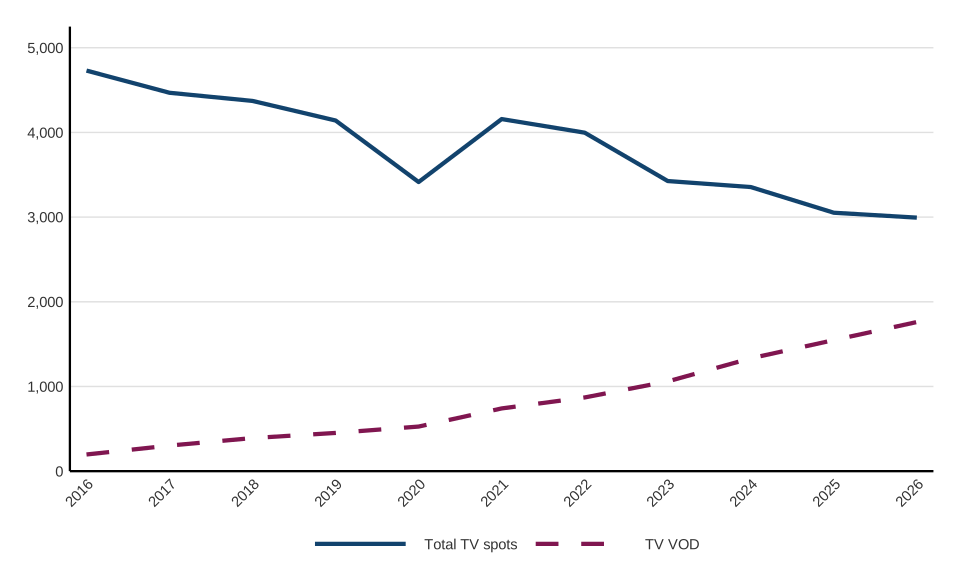
| Year | Total TV spots (GBP Millions) | TV VOD (GBP Millions) |
|---|---|---|
| 2016 | 4730 | 197 |
| 2017 | 4468.1 | 302.2 |
| 2018 | 4371.7 | 391 |
| 2019 | 4140.7 | 451.7 |
| 2020 | 3414.2 | 526.7 |
| 2021 | 4157.8 | 740.8 |
| 2022 | 3996.9 | 870.4 |
| 2023 | 3426 | 1060 |
| 2024 | 3354.9 | 1332.7 |
| 2025 | 3051.7 | 1547.6 |
| 2026 | 2993.8 | 1761 |
Source: Advertising Association/WARC Expenditure Report
Figure 8: PSM Content by Hours Across Genres for First-Run UK Originations
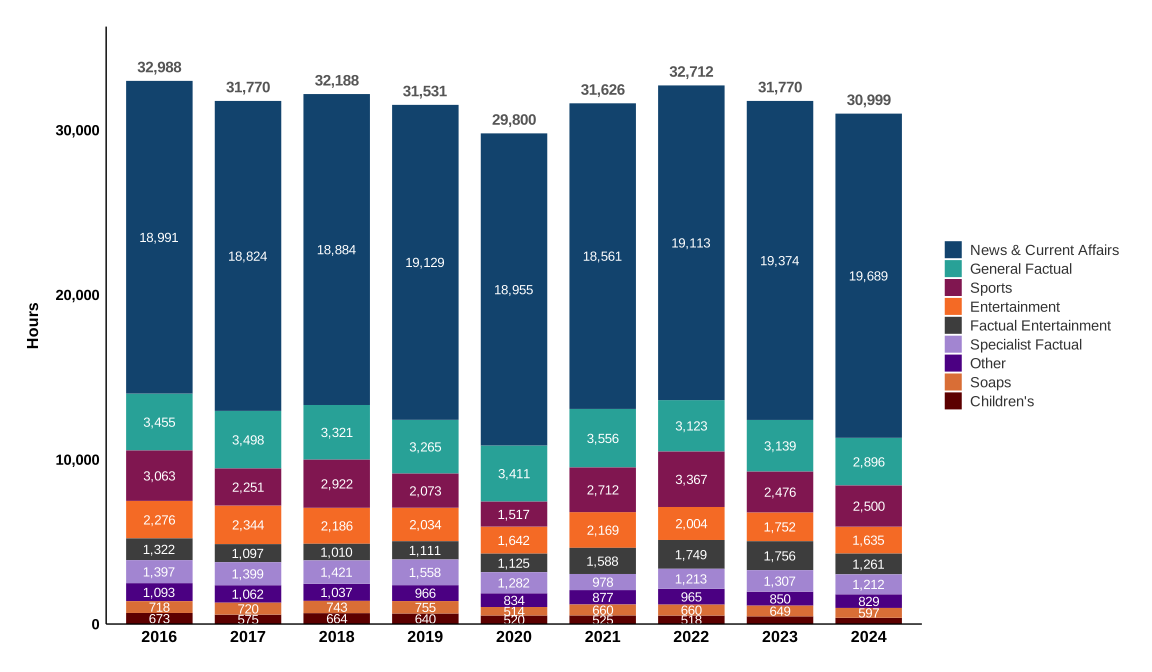
| Genre | 2016 | 2017 | 2018 | 2019 | 2020 | 2021 | 2022 | 2023 | 2024 |
|---|---|---|---|---|---|---|---|---|---|
| News and Current Affairs | 18,991 | 18,824 | 18,884 | 19,129 | 18,955 | 18,561 | 19,113 | 19,374 | 19,689 |
| General Factual | 3,455 | 3,498 | 3,321 | 3,265 | 3,411 | 3,556 | 3,123 | 3,139 | 2,896 |
| Sports | 3,063 | 2,251 | 2,922 | 2,073 | 1,517 | 2,712 | 3,367 | 2,476 | 2,500 |
| Entertainment | 2,276 | 2,344 | 2,186 | 2,034 | 1,642 | 2,169 | 2,004 | 1,752 | 1,635 |
| Factual Entertainment | 1,322 | 1,097 | 1,010 | 1,111 | 1,125 | 1,588 | 1,749 | 1,756 | 1,261 |
| Specialist Factual | 1,397 | 1,399 | 1,421 | 1,558 | 1,282 | 978 | 1,213 | 1,307 | 1,212 |
| Other | 1,093 | 1,062 | 1,037 | 966 | 834 | 877 | 965 | 850 | 829 |
| Soaps | 718 | 720 | 743 | 755 | 514 | 660 | 660 | 649 | 597 |
| Children’s | 673 | 575 | 664 | 640 | 520 | 525 | 518 | 467 | 380 |
| Total hours | 32,988 | 31,770 | 32,188 | 31,531 | 29,800 | 31,626 | 32,712 | 31,770 | 30,999 |
Source: Ofcom/broadcasters from Communications Market Report 2025 - interactive. Figures are nominal and do not include S4C, BBC Alba, BBC HD or nations’/regions’ programming. This graph builds on figure 5 in chapter 1 and uses more detailed data available from Ofcom to break down the content hours of first-run PSM originations into more granular genres, and includes additional genres such as news and current affairs.
The balance of obligations and benefits conferred on our PSM providers is known as the ‘PSM compact’. There is a risk this combination of mounting costs and diminishing benefits will result in a net loss for PSM providers (and potentially for it not to be viable for PSM providers to continue or renew their licences) unless we explore a broad range of options to rebalance the compact.
The government will explore options to reform the UK’s system of public service media for television. The current system of public service media regulation limits the options to diversify the mix of providers and means it is heavily reliant on traditional broadcasters. Moving away from regulating PSM providers through broadcast licences would give more flexibility as to who the providers are, as well as the nature of the benefits and obligations conferred on them, reflecting the new media environment. For example, it could lead to new requirements for PSM providers to create content specifically for video sharing platforms or social media.
Local TV providers are also facing similar challenges regarding changing audience viewing habits and declining advertising revenues. Like national PSM providers, they are regulated by Ofcom through conditions placed in their broadcast licences. Any reform to our system of public service media will consider the parallel system of local TV, and opportunities this could provide for those providers.
Any new regulatory model should result in the creation of more public service content, which has a greater impact on audiences and helps to shape a more democratically engaged and cohesive society. Below we propose four principles for what an updated public service system should deliver.
Potential principles of the public service media system:
- Universality: to ensure that public service content remains universally available, free of charge, reflecting audience behaviours and media consumption habits.
- Public service content: to ensure provision of a wide range of high-quality, distinctive public service content.
- Systemic sustainability: to ensure the system of public service media has a mix of providers to increase its resilience to deliver public service media objectives in the long-term. It should also be sufficiently flexible to adapt to the potential shifts of the current collection of PSM providers and be open to opportunities of mergers, partnerships, and definitions of public service content.
- A sustainable PSM compact: to ensure the benefits PSM providers receive are proportionate to the obligations they must deliver for PSM status so as to be attractive and commercially sustainable.
We also recognise that PSM providers are part of a diverse market, and dynamic mixed ecology that we want to maintain. In particular, a strong independent production system, with sustainable production centres across the UK, is important to ensure the provision of high-quality public service content. PSM providers commissioning and investment via jobs and infrastructure helps build critical mass and creates opportunities for domestic producers, crews, talent and other workers. The BBC has an important role to play here. One of the key objectives of the BBC Charter Review is a BBC that supports the sector, and drives opportunity and good jobs across the nations and regions of the UK which it must do in collaboration with other PSM providers and the wider TV sector. Any changes to the system of public service media should not come at the cost of wider sector growth.
Below we present three illustrative models to demonstrate how systemic reform could meet the challenges and objectives laid out in previous sections. Each is a mixed model, retaining the BBC’s role as our largest PSM provider. The ecosystem around this then helps inform what role the BBC plays and its remit, including how it can leverage its public funding to meaningfully partner and collaborate with other PSM providers. The ways that the BBC partners with others in the sector, including PSM providers, in a way that strengthens the wider media ecosystem, is also being considered through the BBC Charter Review.
Illustrative models of a new system of public service media
A model focused on PSM institutions would see institutions, such as broadcasters or streamers, designated as PSM institutions. In this way, public service content would be, as it is today, clearly associated with a defined set of institutions, so audiences would know who they are. In terms of their regulation, they could still be subject to individual public service remits, as well as requirements to contribute to an overall public service remit for television. This approach would be most similar to the UK’s current regulatory system, and so would preserve many of its strengths (for example, strong institutional public service media ethos among providers). The system could provide for a two-tier system of ‘full’ providers and smaller providers or services with corresponding levels of benefits and obligations. This could help support a small number of additional PSM institutions.
A model focused on PSM services would allow specific ‘services’ to receive PSM designation if they were to meet agreed requirements. In this context, ‘services’ could range from linear provision, such as an arts-focused TV channel, to a high-quality video-on-demand service, or channels on video sharing platforms, such as a history or documentary channel on YouTube. Having a wider range of providers could mean it is less clear for audiences seeking public service content to know where to find it. It could, however, increase the likelihood of audiences interacting with public service content, including audiences who have become disengaged with public service media, particularly if algorithms can be leveraged to deliver public service content to audiences on platforms. Regulation could involve obligations and benefits (for example, prominence) being applied to individual services. This model could open up the system to a wider range of providers, and enable more flexible and dynamic regulation of public service media.
A content-centric approach would determine whether something is public service content subject to an agreed definition (which could evolve in line with cultural/societal needs) rather than a particular institution or service. The value of public service media could extend to more audiences as people engage with public service content no matter their viewing behaviours, reflecting an environment where content is increasingly served algorithmically. It could be adaptable to audience and technological shifts and not reliant on the success of specific organisations. Benefits, such as funding for and prominence of public service content, would also be tied directly to the content itself. In practice, countries whose systems of public service media are more content-centric tend to adopt a mixed model whereby a small number of PSM institutions are supported by additional incentives to support the supply of public service content.
The government’s ambition for public service media
Despite the transformative changes to how people are consuming media, we believe there is still strong demand, and an irrefutable need, for public service media. Audiences still value, and want access to, accurate news, and informative and entertaining content that reflects the diversity of the UK and brings audiences together. We want a regulatory system that encourages the creation of more public service content, reversing the trend of recent years which has seen the output of our PSM providers decline. We also want to make sure that the benefits public service media delivers help to address the challenges associated with the modern media ecosystem. As discussed in section 2.3, this might include adding new obligations to the PSM compact, such as enhanced responsibilities for media literacy, which are crucial for society in the digital age.
To achieve this, our preferred model of public service media will need to work as part of the final decision that is reached on the future of TV distribution (section 3.1). This is vital both for ensuring that access to PSM content remains universal, and that the costs of being a PSM provider are balanced with appropriate benefits. The final approach that the government sets out will need to fully reflect the paradigm shift from broadcasting to content everywhere, as set out in chapter 1. This change is fundamentally altering how and where PSM providers need to make their content available, and where we want to ensure PSM content is accessible and prominent.
Our ambition is for a system of public service media that thrives and leans into the opportunity of new technologies. Those technologies may lower the cost of distribution or potentially reduce the cost of content creation, while the algorithmic serving of content allows for PSM content to be offered directly to audiences we want to engage. We are supportive of PSM providers developing algorithms in line with public service values, that strike the right balance between offering audiences personalised services while still ensuring they are exposed to a wide range of PSM content that keeps them informed about the world around them. The BBC Charter Review green paper consulted on what further obligations the BBC specifically should have to ensure a broad range of PSM content is promoted within its own platforms.
As set out in section 1.4, we are supportive of strategic partnerships among PSM providers that benefit their financial sustainability and audiences. We would expect the adoption of new technologies to present opportunities for such partnerships, with the potential to rationalise costs and increase investment in creating PSM content. We want to encourage innovation that is spearheaded by PSM providers. While this activity will be market led, we welcome views on how our reforms, to PSM regulation and more broadly, can support this.
Consultation questions
Introductory question
Question 1. The green paper covers topics relating to the future of UK television and media. More specifically, it includes content on:
- the current market and audience context
- prominence of news and of public service media
- future of TV distribution and regulation
- a new system for public service media
- media literacy
What are your overall views on the future of television and media in the UK, related to the topics in this green paper?
Market and audience context
Question 2. Chapter one of the green paper describes a series of challenges impacting the UK’s TV production ecosystem, including:
- the spending power of public service media (PSM) providers is decreasing, which impacts their ability to commission new content
- the sector faces rising production costs and inflationary pressure, particularly for high-end content like drama
- PSM providers are adopting ‘fewer, bigger and better’ commissioning strategies, often prioritising digital-first content, which has resulted in fewer commissions for some genres
- when global streaming platforms commission directly, they typically retain the IP. This inward investment, while filling production expenditure gaps, risks shifting the residual commercial value offshore, creating a challenge for producers to retain IP and long-term economic value
- screen-based businesses report unmet finance demand and feel underfunded, despite a high rate of actively using external finance
What measures do you feel would be most effective for the government to take to overall address these challenges?
Prominence of news on social media
Question 3. How often do you encounter news you feel is untrustworthy when online (for example, something you consider to be misinformation)?
Options:
- Never
- Rarely
- Sometimes
- Often
- Very often
- Not sure
Question 4. Do you believe ‘trustworthy’ news content should be more visible on social media? Options:
- Yes
- No
- Not sure
Question 4a. How would you like this to look in practice, so that audiences can access trustworthy news more easily on social media?
Question 5. If the government gives prominence to trustworthy providers of news (meaning by making them more visible online), should this prominence be ongoing, and ‘always on,’ or only active during periods of crisis?
Options:
- Ongoing and ‘always on’
- Only during periods of heightened vulnerability
- Not sure
Question 6. Do you feel individual users should be given an option in whether prominence measures for trustworthy news content are switched on or off for them?
Options:
- Yes - users should be given an option in whether prominence measures are switched on or off for them
- No - users should not be given an option in whether prominence measures are switched on or off for them
- Not sure
Media literacy duty and joint venture
Question 7. How concerned, if at all, are you about the impact of misleading or unreliable information on society?
Options:
- Very concerned
- Somewhat concerned
- Not very concerned
- Not at all concerned
- Not sure
Question 8. How concerned, if at all, are you about the impact of misleading or unreliable information on democracy?
Options:
- Very concerned
- Somewhat concerned
- Not very concerned
- Not at all concerned
- Not sure
Question 9. Public service media refers to organisations such as the BBC, ITV, Channel 4 and S4C.
Which of the following statements most closely reflects your view on the role of public service media in helping people critically engage with news and other information they encounter online or offline? (select only one)
Options:
- Public service media has a role in supporting critical engagement, and is currently doing enough
- Public service media has a role in supporting critical engagement, and should do more
- Public service media does not have a role in supporting critical engagement
- Public service media is currently doing too much to support critical engagement, and should do less
- Not sure
Question 10. How important, if at all, do you think it is for people to be able to judge the accuracy and reliability of information they encounter, for example online or in the news?
Options:
- Very important
- Somewhat important
- Not very important
- Not at all important
- Not sure
Question 11. How valuable, if at all, do you believe collaboration between public service media, civil society organisations (for example charities and education groups), and the media sector could be in supporting people to critically assess information?
Options:
- Very valuable
- Somewhat valuable
- Not very valuable
- Not at all valuable
- Not sure
Question 12. Which of the following models, if any, do you consider most effective for further media sector collaboration in this area?
Options: (select all that apply)
- Informal coordination and sharing of learning
- A structured forum with agreed objectives and reporting
- Joint delivery of public-facing initiatives
- No additional collaboration is needed
- Not sure
Question 12a. Please provide any supporting evidence as to why you think the model(s) you selected are effective for collaboration between public service media and the media sector.
Future of TV distribution
Question 13. Chapter 3.1 of the green paper outlines the government’s preference for an IPTV transition from either 2034 or 2044. The following questions seek views and evidence relating to this proposal.
To what extent do you agree or disagree with the government’s assessment of the case for change relating to the future of digital terrestrial television?
- Strongly agree - audiences should definitely adopt Internet Protocol Television (IPTV) and similar technologies
- Agree - audiences should adopt IPTV and similar technologies
- Neither agree nor disagree - no strong opinion either way
- Disagree - audiences should not adopt IPTV and similar technologies
- Strongly disagree - audiences should definitely not adopt IPTV and similar technologies
- Not sure
Question 13a. Please provide further rationale for your answer and any relevant evidence.
Question 14. The green paper outlines two timing options for digital terrestrial television (DTT) switch-off. These are 31 December 2034 (option 1 at Annex A) and 31 December 2044 (option 2 at Annex A).
Which option do you prefer as timing for DTT switch-off?
Options:
- Strongly prefer 2034
- Somewhat prefer 2034
- No strong opinion either way
- Somewhat prefer 2044
- Strongly prefer 2044
- Neither 2034 or 2044
- Not sure
Question 14a. Please provide further rationale for your answer and any relevant evidence.
Question 15. Do you have evidence that another timeframe is preferable to the ones specified in this consultation? If so, please provide further details.
Question 15a. For industry/organisations only:
To deliver an IPTV transition would require collaborative working with audience groups, industry and across government. Please outline your organisation’s commitment to supporting this work, including relevant experience, resources, and innovative solutions as to how you would deliver this transition.
Question 16. To what extent do you agree or disagree that the challenges identified in the green paper (delivering for all audiences; maintaining a reliable television service; promoting competition and innovation in the television industry and supporting a sustainable future for PSM providers) capture all of the considerations when making a decision on whether, and how best, to support audiences to adopt IPTV and other similar technologies?
- Strongly agree - the challenges comprehensively capture all of the considerations when making a decision on whether, and how best, to support audiences to adopt IPTV and other similar technologies
- Agree - the challenges capture all of the considerations
- Neither agree nor disagree - no strong opinion either way
- Disagree - the challenges do not capture all of the considerations
- Strongly disagree - the challenges definitely do not capture all of the considerations
- Not sure
Question 16a. Please provide further rationale for your answer.
Question 17. In your opinion, which, if any, of the challenges are most important to you? Please rank in order of importance, where 1 is the most important to you.
Options:
- Delivering for all audiences - Any transition to IPTV and other similar technologies must preserve universal access to TV, including public service media providers, regardless of income, location, age, or digital confidence.
- Maintaining a reliable television service - The ability to communicate to the public in a national emergency must be retained beyond a move to IPTV. Before digital terrestrial television is switched off, industry must show that alternative technologies can deliver comparable or better standards of reliability, resilience, and coverage.
- Promoting competition and innovation in the TV industry - A managed transition to IPTV and other similar technologies offers an opportunity to modernise TV delivery, the transition should free up resources and spectrum, and allow broadcasters to focus on content and innovation rather than maintaining parallel legacy systems.
- Supporting a sustainable future for public service media providers - public service media providers play a central role in the UK’s cultural, civic, and democratic life. Industry must ensure that new distribution models support, rather than undermine, public service media providers’ ability to play this role.
Question 18. In the event of an IPTV transition, which of the following, if any, do you think are the most important to ensure everyone can still access television from their own home? Please rank in order of importance, where 1 is the most important to you.
Options:
- Affordable broadband for all, suitable for television viewing
- Low-cost or subsidised broadband for people receiving benefits or on low incomes
- Low-cost or discounted internet capable television sets for people on low incomes
- Simple devices that connect older television sets to the internet with no ongoing fees
- Services and systems that feel the same as digital terrestrial television so they are easy to use for people with limited digital skills
- Built-in, easy to use accessibility features for disabled users, for example subtitles and audio description
- Digital skills required to navigate or set up IPTV
Question 19. What are the likely environmental impacts associated with both a 2034 transition and 2044 DTT switch-off (transition to IPTV)?
In your response, please provide evidence where possible on:
- The comparative energy use and carbon emissions of different distribution technologies.
- The environmental implications of changes in viewing behaviour (for example, increased streaming or on-demand consumption)
- The lifecycle environmental impacts of relevant infrastructure and consumer equipment (such as transmitters, network infrastructure, set-top boxes, and connected televisions)
- Opportunities to improve the environmental sustainability of television distribution, including through technological innovation, infrastructure efficiency, or consumer behaviour
- Any risks that policy decisions on the future of TV distribution could unintentionally increase environmental impacts
Please include any available data, modelling, or research that could inform the government’s assessment of environmental impacts.
Question 20. Is there anything else you would like to add regarding the future of TV distribution that has not already been captured?
Future of TV regulation
Question 21. Chapter 3.2 of the green paper sets out some of the challenges regarding the future of TV regulation, such as which TV-like services should be regulated going forward, and to what standard. Is there any information or comment you would like to provide in relation to the future of TV regulation?
Prominence of PSM content in the platform age
Question 22. How easy or difficult is it for you to find culturally relevant content on video platforms, including video sharing platforms like YouTube and TikTok and streaming platforms like Netflix and Amazon Prime Video?
Examples of culturally relevant content could include stories set in Britain, with British presenters, representing British values or referencing British events or customs.
Options:
- Very easy - I have no issues in finding culturally relevant content on these platforms
- Somewhat easy - I have very few issues in finding culturally relevant content on these platforms
- Neither easy nor difficult - no opinion either way
- Somewhat difficult - I have some issues in finding culturally relevant content on these platforms
- Very difficult - I have a lot of issues in finding culturally relevant content on these platforms
- Not sure
Question 23. Prominence can be defined as giving certain content a privileged position, for example, ensuring a specific channel appears at the top of search results or features on a recommendation feed, within a user interface so it is particularly easy for audiences to find and watch.
To what extent do you agree or disagree that content from public service media providers (like the BBC and Channel 4) should be easier to find on video platforms?
Options:
- Strongly agree - it should definitely be easier to find Public Service Media content on these platforms
- Agree - it should probably be easier to find public service media content on these platforms
- Neither agree nor disagree - no opinion either way
- Disagree - it should probably not be easier to find public service media content on these platforms
- Strongly disagree - it should definitely not be easier to find public service media content on these platforms
- Not sure
Question 23a. What do you see as the benefits of content from public service media providers (like the BBC and Channel 4) being easier to find on video platforms?
Question 23b. What types of content from public service media providers do you think should be easier to find on video platforms? (select all that apply)
Options:
- Arts and classical music
- Children’s
- Comedy
- Drama
- Education
- Entertainment
- Factual entertainment
- Feature films
- General factual
- News and current affairs
- Religion and ethics
- Soaps
- Specialist factual
- Sports
- None of the above
- Other (please specify)
Question 23c. On which video platforms do you think content from public service media providers should be easier to find?
Question 24. Do you regularly create video content and upload it to video sharing platforms, such as YouTube and TikTok?
Options:
- Yes, primarily for fun or as a hobby
- Yes, primarily for professional purposes or to generate income
- No
- Prefer not to say
Question 24a. As a content creator or someone who uploads content to video sharing platforms, are there additional changes or features that you would want video sharing platforms to offer? For example to increase the visibility of your content, transparency of systems or to make content more discoverable.
Question 24b. Thinking about the video sharing platforms you upload and share content on, do you have sufficient awareness of how content is shown to viewers through the algorithms?
Options:
- I have sufficient awareness of how the algorithm works
- I do not have sufficient awareness of how the algorithm works
- Not sure
A new system of public service media for television
Question 25. Which of the following, if any, attributes of public service media content do you value the most? Please select (up to) your top three.
Options:
- Diverse programming - content that features people like me, and people from different backgrounds
- Quality news - news content that is accurate, and helps me better understand what is going on in the world today
- Regional coverage - programming or content that keeps me informed about my area
- Quality content (non-news) - programmes or content that you see as high-quality and or different in their approach to what is offered by other providers
- Range - the availability of a range of different types of programmes (for example drama, comedy, entertainment, sport)
- Tailored to UK audiences - programmes that are specifically made for UK audiences, and are relevant to me
- Shared viewing opportunities - programmes and broadcast events that I can watch and talk about with others, for example family or my peers
- National cohesion - the broadcasting of events that bring the nation together for a shared viewing experience
- None of the above
- Not sure
Question 26. Chapter 4.2 of the green paper outlines the challenges public service media faces and how the system tied to broadcast licences is relatively inflexible. The chapter suggests this limits the options for benefits and obligations Ofcom can place on public service media providers, and makes it harder to open up the system to new providers. It is argued this risks the sustainability of the system as audiences move away from live broadcast TV to switch between linear, on-demand, and user-generated content on multiple devices.
To what extent do you agree or disagree with the suggestion that the public service media system needs to be reformed away from the current model that uses broadcast licences?
Options:
- Strongly agree - the system definitely needs to be reformed away from using broadcast licences
- Agree - I agree that the system may need to be reformed away from using broadcast licences
- Neither agree nor disagree - No opinion either way
- Disagree - I do not agree that the system necessarily needs to be reformed away from using broadcast licences
- Strongly disagree - I feel strongly that the system should continue to use broadcast licences
- Not sure
Question 26a. Please provide a reason and any supporting evidence for your view.
Question 27. The green paper outlines four potential principles of the public service media system.
In brief, these are:
- Universality: to ensure that public service content remains universally available, free of charge, reflecting audience behaviours and media consumption habits.
- Public service content: to ensure provision of a wide range of high-quality, distinctive public service content.
- Systemic sustainability: to ensure the system of public service media has a mix of providers to increase its resilience to deliver public service media objectives in the long-term. It should also be sufficiently flexible to the potential shifts of the current collection of PSM providers and be open to opportunities of mergers, partnerships, and definitions of public service content.
- A sustainable PSM compact: to ensure the benefits PSM providers receive are proportionate to the obligations they must deliver for PSM status so as to be attractive and commercially sustainable.
To what extent do you agree or disagree that each of the following should be considered by government as principles of the public service media system?
- Universality
- Options: Strongly Agree, Agree, Neither agree nor disagree, Disagree, Strongly Disagree, Not sure
- Public service media content
- Options: Strongly Agree, Agree, Neither agree nor disagree, Disagree, Strongly Disagree, Not sure
- Systemic sustainability
- Options: Strongly Agree, Agree, Neither agree nor disagree, Disagree, Strongly Disagree, Not sure
- A sustainable public service media compact
- Options: Strongly Agree, Agree, Neither agree nor disagree, Disagree, Strongly Disagree, Not sure
Question 28. The green paper outlines three illustrative models for our public service media system to align with our proposed principles. These models are outlined below, and a more detailed description on each is presented in chapter 4 of the green paper.
- A model focused on PSM institutions would see institutions, such as broadcasters or streamers, designated as PSM institutions.
- A model focused on PSM services would allow specific ‘services’ to receive PSM designation if they were to meet agreed requirements. In this context, ‘services’ could range from linear provision, such as an arts-focused TV channel, a high-quality VoD service, or channels on video sharing platforms, such as a history or documentary channel on YouTube.
- A content-centric approach would determine whether something is public service content subject to an agreed definition (which could evolve in line with cultural/societal needs) rather than a particular provider (institution or service).
Please rank, in order, your preferred model of the public service media system, where 1 is your most preferred model:
Options:
- A model focused on PSM institutions
- A model focused on PSM services
- A content centric approach
- A combination of the models
Question 29. Do you have any further comments you would like to add on the content covered by this chapter, or any further information that will aid us in interpreting your responses?
Equalities impact
Question 30. There is a duty on public authorities to consider how their policies or decisions affect people with protected characteristics under the Equality Act 2010.
Do you have any evidence of the equalities impacts of any proposals set out in the consultation?
Annexes: Future of TV distribution
Annex A: Options assessment
Options assessment
This section outlines the case for a managed transition away from DTT, highlighting the risks of inaction and the key considerations for government. The government considers such a transition inevitable for reasons covered in chapter 3 (3.1). The policy choice is therefore between two managed transition timelines, with 2034 offering earlier benefits but requiring earlier intervention.
The government is committed to ensuring that everyone can continue to enjoy high-quality television services as technology evolves. As more households choose to watch TV over broadband, we want to make sure viewers have the access, support and confidence they need to benefit from any changes.
With continued progress in rolling out gigabit broadband coverage nationwide and ongoing work to improve digital inclusion, we believe any transition to IPTV could offer an opportunity to enhance choice, reliability and viewing experiences for audiences across the country.
To support this work, the Department for Culture, Media and Sport (DCMS) first asked Ofcom to undertake an early review of market changes that may affect the future of content distribution on DTT and other distribution platforms.[footnote 57] Their report identified three broad approaches for the future of DTT:
- Invest in a more efficient DTT service.
- Reduce DTT down to a core service (known as a ‘nightlight’).
- Move towards DTT switch-off over the 2030s.
DCMS has carried out extensive research and analysis to further develop these proposals. This work has been done across government and in close collaboration with audience groups, industry representatives and academics – including through the Future of TV Distribution Stakeholder Forum.
Drawing on this evidence, we refined a broad range of possible approaches into a shortlist of three specific options. The proposed timings align with the rationale set out in chapter 3 (section 3.1), particularly under ‘timing considerations.’
Given the range of technologies involved and the different timescales for implementation, there were many potential models and a variety of stakeholder views. Inevitably, some options were not taken forward. However, input from the stakeholder forum, alongside wider engagement and additional research, provided a strong and balanced evidence base to support the shortlist, as detailed below.
Option 0 (baseline for comparison purposes and not being considered) - Allow the market to determine outcomes: In this scenario, the government would take only the action necessary to ensure the continuity of public service broadcasting. This would include repealing requirements on our public service media providers to distribute their channels via DTT, though they could choose to do so if they wished. Internet Protocol TV (IPTV) would likely keep growing, mostly by taking viewers away from DTT. Commercial TV companies might stop using DTT altogether, which would leave our public service media providers having to pay more of the costs on their own, and increase the incentive on any remaining audiences to migrate to other platforms. By means of comparison, TV companies in countries such as Finland and Sweden are beginning to cut back on or stop their Freeview-style TV services that rely on aerial provision. In such a scenario in the UK, there is a risk that DTT broadcasting could cease in an accelerated and disorderly manner that leaves people reliant on the platform without guidance or support or with no access at all. Other TV platforms distributed via IPTV, satellite, and cable would also decide for themselves whether it still makes business sense to keep operating. The government does not consider this option viable due to the risk of adverse impacts on audiences and it is only included here to serve as a point of comparison.
Option 1 (under consideration for consultation) - Managed transition to IPTV by 2034[footnote 58]
Under this scenario, the government would implement an industry-led transition to IPTV services. There would be no extension of the DTT platform beyond 2034, so this transitional support would be put in place ahead of that date, and all of the radio spectrum currently used by DTT could be released in 2035. The focus would be on ensuring that everyone can continue to access and enjoy television, including live channels, on-demand programmes and PSM content, as viewing increasingly moves online. This would include practical assistance, clear information and targeted support for households who may find the change more challenging. We recognise that some audiences, including older viewers, those living in rural areas, disabled people and those on lower incomes are less likely to have reliable internet access or the digital skills needed to watch TV online. Without appropriate support, these groups could face barriers to accessing the television services they rely on and we would therefore direct support measures at them especially. The intention is to ensure that the shift to IPTV strengthens, rather than diminishes, access to affordable, high-quality television for all audiences. This would focus all stakeholders on addressing the challenges we have identified to maintain universal access to television ensuring affordable, reliable broadband, usability, and digital skills. The government anticipates that satellite and cable television would continue on a purely commercial basis.
Option 2 (under consideration for consultation) - Managed transition to IPTV by 2044
As with option 1, the government would implement an industry-led transition to IPTV services by 2044. However, this option provides a 10-year extension to the life of the DTT platform, alongside targeted investment intended to reduce the operating costs passed onto broadcasters. Instead of the six multiplexes in operation today, the platform would operate with three multiplexes during this period. This approach would maintain DTT as a service without reducing its overall reach. At the same time, reducing the number of multiplexes from six to three would enable the targeted release of valuable radio spectrum for alternative uses. Public service media providers would continue to have DTT broadcast obligations during the transitional period, but according to pricing figures provided by Arqiva the cost of DTT carriage would be considerably reduced in comparison to current annual charges. These lower carriage costs could also encourage commercial channels to remain on the platform. Satellite and cable television services are expected to continue operating on a fully commercial basis, as they do now. As audiences increasingly migrate to IPTV, the economic case for broadcasting on DTT is likely to become more challenging. Linear television advertising has traditionally depended on large, simultaneous audiences to secure premium advertising revenues. As viewing audiences shrink and fragment, commercial broadcasters may need to take commercial decisions about the long-term viability of remaining on the DTT platform.
For the reasons set out in chapter 3 (3.1), and following engagement with both the Stakeholder Forum and other stakeholders, the government believes there is a compelling case for a transition from DTT to IPTV services by 2034. But, recognising the challenges that would need to be overcome, the government is clear that the transition must happen in the right way, ensuring no one is left behind. Through this green paper, the government is setting out the principles for the transition pathway, as well as seeking views on 2044 as a potential transition date, in order to hear and consider a broad range of perspectives. The responses to this consultation will therefore help to inform the decision as to which of these options (or another option) will be pursued.
As part of this consultation, we are gathering information to inform our assessment of these options under the Public Sector Equality Duty and to understand any potential impacts on individuals with protected characteristics.
Annex B: Challenges to be addressed prior to the switch-off of DTT services
This section sets out the main factors that will influence a successful transition away from DTT, and the role of any supporting measures.
Despite the steadily increasing shift towards the use of IPTV, transitioning from DTT to a fully IPTV-based system will require structured support.[footnote 60] The government has identified four challenges that any transition plan including an audience support package must overcome. These are centred around the principles of 1) universality, 2) reliability, 3) innovation and 4) PSM sustainability. Regardless of the eventual transition timeline, a support package will be needed to help audiences move from DTT to IPTV smoothly and with confidence. These interventions will be co-designed with industry and other partners.
As well as identifying the challenge to be addressed as part of that package, each pillar below sets out:
- proposed outcomes
- potential interventions to be led by industry[footnote 61]
- the role government could play
We have provided these to be illustrative and are looking to industry to work together and propose solutions with their plan for delivering this against the intended outcomes.
Challenge 1: Delivering for all audiences
Everyone that wants to is able to access television in their home — no one is left behind.
Television plays a vital cultural and social role, providing trusted news, shared national moments, and access to PSM content. Any transition away from DTT should preserve universal access to TV, including PSM providers, regardless of income, location, age or digital confidence.
Stakeholders have highlighted a range of potential approaches that industry and government could explore to address these challenges. The examples below are intended to illustrate possible areas for action rather than a defined set of interventions. Industry intervention could include:
- Ensuring that households are not priced out of television as a result of the transition, for example through financial support from wider industry likely to benefit from the transition.
- Ensuring affordable access to connectivity and services:
- Supporting the continued availability of low-cost offers (such as social tariffs) that enable affordable access to TV content.
- Contributing to the shared ambition that all households who need broadband connectivity to access television are able to obtain it, recognising the role of government intervention (including programmes such as Project Gigabit) alongside industry delivery.
- Offering simple, low-cost IPTV devices (such as ‘plug-in’ or ‘dongle’ solutions), with clear pricing and no unnecessary ongoing fees.
- Designing inclusive and accessible services:
- Ensuring IPTV services are simple to set up and easy to use.
- Working with device manufacturers, platforms, and service providers to promote inclusive design that caters to a wide range of digital capabilities.
- Ensuring services are accessible by default.
- Supporting digital capability and confidence:
- Playing a role in improving digital skills through funding and delivering training initiatives.
- Working with local authorities, charities, and community groups to support digitally excluded users.
- Ensuring easy access to content:
- Demonstrating that content from PSM providers, alongside a broad range of other content, remains freely and easily accessible without requiring premium subscriptions or complex bundles.
Government intervention could include:
- Setting clear expectations for affordability and accessibility of IPTV services and devices, to ensure households are not excluded from television as services evolve
- Ensuring the delivery of nationwide connectivity coverage, in line with existing government targets and programmes (including Project Gigabit)
- Coordinating and strengthening digital inclusion efforts, by drawing together activity across government, local authorities, charities, and community groups to support the skills and confidence needed to use IPTV services
Challenge 2: Maintaining a reliable television service
Any replacement for DTT meets similar standards of reliability.
For DTT to be switched off, industry should demonstrate that alternative platforms can deliver comparable or better levels of coverage and reliability. By reliability, IPTV should be able to provide a service that is as consistent as DTT.
Relatedly, the government understands the importance of information access in times of national emergency. Television and radio both play an important role in providing such access in a range of different emergency scenarios, including scenarios where other communications may be disrupted. The ability to communicate to the public in a national emergency should be retained beyond a move to IPTV.
Industry intervention could include:
- Investing in broadband and content delivery networks to:
- Support peak live viewing at national scale, alongside concurrent broadband use.
- Maintain service during major events and emergencies.
- Providing clear reliability standards and service guarantees.
- Demonstrating robust contingency planning for outages, congestion, or failures.
- Working collectively across the sector to avoid fragmented or inconsistent service quality.
Government intervention could include:
- Requiring evidence that standards are being met before DTT switch-off.
- Conducting research to evaluate broadband network capacity requirements in an IPTV-only environment and determine how this differs from the existing situation.
- Ensuring that effective plans are in place to address any adverse impacts on radio and on emergency broadcasting relating to a potential DTT switch-off.
Challenge 3: Promoting competition and innovation in the television industry
The transition unlocks innovation and audiences continue to enjoy choice, diversity, and competition.
Moving away from DTT offers an opportunity to modernise TV delivery. The transition should free up resources and spectrum, and allow broadcasters to focus on content and innovation rather than maintaining parallel legacy systems.
Industry intervention could include:
- Developing and using open, interoperable IPTV solutions that:
- Work across networks, devices, and platforms.
- Avoid locking broadcasters or audiences into proprietary ecosystems.
- Reinvesting savings from modernised distribution into:
- UK content.
- New services.
- Improved accessibility and user experience.
- Learning from international experience and adopting proven approaches.
- Agreeing on fair, transparent, and non-discriminatory carriage arrangements.
- Ensuring platforms can technically support a wide range of channels and services.
- Avoiding practices that limit competition, choice, or market entry and ensure consistency with policies that safeguard net neutrality.
Government intervention could include:
- Providing regulatory clarity and long-term certainty.
Challenge 4: Supporting a sustainable future for PSM providers
PSM content remains sustainable and widely available.
PSM providers play a central role in the UK’s cultural, civic, and democratic life. Industry should ensure that new distribution models support, rather than undermine, PSM providers.
Industry intervention could include:
- Ensuring content from PSM providers is:
- Free at the point of use.
- Easy to find and that it is easy to navigate between services, on all devices.
- Available on all major IPTV platforms and devices.
- Supporting technical and commercial arrangements that allow PSM providers to:
- Reach mass audiences and be available in every UK home.
- Invest in high-quality UK content.
- Working collaboratively on sustainable distribution models.
The government will look to:
- Ensure PSM providers retain universal reach and prominence.
The government will continue to refine these challenges and provide greater clarity on metrics and targets following responses to this green paper.
Annex C: Cost-benefit analysis
In the following section we have provided an initial cost-benefit analysis for the two main options: Option 1, a managed IPTV transition by 2034; and Option 2, a managed IPTV transition by 2044. This is not intended to be final analysis to inform a decision, but to allow the members of the public and industry to understand and provide input on the government’s current understanding of the costs and benefits attributed to each option.
These two main options are compared to a set of assumptions that make up a baseline: Option 0, allowing the market to determine outcomes. For this baseline, we assume for simplicity the following: (1) by 2034, all broadcasters stop distributing over DTT infrastructure; (2) government/broadcasters do not organise a communications or support programme to aid households in this transition; (3) households without broadband adopt broadband at the same rate they would have based on current forecasts; and (4) due to the unplanned nature of the loss of DTT infrastructure, there is no plan to auction the now unused 500 MHz and 600 MHz bands of spectrum for other purposes. In future analysis we will further develop this baseline.
A. Summary
For each monetised impact, we calculate a central figure representing the best estimate based on available data. However, due to several unmonetised impacts; uncertainty of the baseline; and uncertainty in some key variables, these estimates should be treated with caution, as each of these could influence the value for money of either option. Small changes in inputs (for example,. household forecasts, broadband prices, future mobile network traffic) significantly change the monetised impacts. As such, due to the overlapping monetised ranges and uncertainty in these numbers, as well as the impact of the unmonetised impacts, this analysis makes no recommendation at this time between the two options.
Where possible, we have provided reasonable low and high estimates to build a total high and low scenario: with low indicating a pessimistic cost-maximising, benefit-minimising scenario; and high indicating an optimistic cost-minimising, benefit-maximising scenario. Further sensitivity testing will also be required, such as the impact of adjustments in household forecasts regarding the rate of IPTV and broadband uptake, as well as testing the impact of higher and lower internet traffic usage on mobile network operator cost savings. The figures in the table below are presented in present value, 2026 prices. They are discounted using the Green Book discount rate of 3.5%.
Our initial cost-benefit analysis does not account for the need to upgrade legacy television infrastructure in a number of commercial and non-domestic premises (such as hotels, hospitals, and prisons). These costs will be evaluated in more detail during subsequent stages of policy development.
Monetised impacts
| PV, 2026 Prices (using GDP deflator), rounded appraisal period: 2026 to 2044/54 Spectrum benefits only to 2054 |
Option 1: Managed IPTV transition by 2034 (w/low-high range) |
Option 2: Managed IPTV transition by 2044 (w/low-high range) |
|---|---|---|
| Costs | £2,135m (£1,850m to £2,270m) |
£1,590m (£1,435m to £1,615m) |
| Social costs of broadband for households without broadband or IPTV-capable broadband | £1,600m (£1,500m to £1,700m) |
£200m (£180m to £220m) |
| Social costs of IPTV devices (such as a Freely TV streaming device) for households without IPTV-capable devices |
£125m (£120m to £130m) |
£20m (£15m to £25m) |
| Communications programme (public awareness campaign, user support, skills training, etc) |
£410m (£230m to £410m) |
£290m (£160m to £290m) |
| DTT annual network costs (costs that multiplex operators pay to infrastructure provider) |
£0m (No low/high scenario) |
£820m (No low/high scenario) |
| DTT 600MHz clearance programme costs (transmitter and antenna replacements, labour costs, etc) |
£0m (No low/high scenario) |
£260m (No low/high scenario) |
| Benefits | £3,500m (£3,300m to £3,600m) |
£3,260m (£2,960m to£3,360m) |
| DTT radio cost-savings (mitigation of new radio costs to broadcasters from loss of DTT annual network fees) |
£0m (No low/high scenario) |
£160m (No low/high scenario) |
| Mobile network operators cost-savings, via spectrum release (2026 to 2054) |
£3,500m (£3,300m to £3,600m) |
£3,100m (£2,800m to £3,200m) |
| Net present value | £1,365m (£1,030m to £1,750m) |
£1,670m (£1,345m to £1,925m) |
Final figures have been rounded to 2 significant figures, and totalled for summary figures.
Unmonetised Impacts
| Option 1: Managed IPTV transition in 2034 | Option 2: Managed IPTV transition by 2044 | |
|---|---|---|
| Costs | DTT infrastructure decommissioning costs in 2035 | DTT infrastructure decommissioning costs in 2045 |
| Costs | Not applicable | Replacing DVB-T-only televisions by 2035 |
| Costs | Increased internet traffic costs (to broadcasters) | Not applicable |
| Costs | Potential additional wider (non-TV) digital inclusion support programme | Potential additional wider (non-TV) digital inclusion support programme |
| Benefits | Alternative PSM usage of annual DTT funding savings (for example, content, innovation) | Not applicable |
| Benefits | Not applicable | Cost-savings to other mast users (excluding radio) from mitigating loss of DTT annual network fees |
| Benefits | Use benefits from MNOs network improvements due to usage of 500 MHz and 600 MHz spectrum bands | Use benefits from MNOs network improvements due to usage of 500 MHz and 600 MHz spectrum bands |
| Benefits | Digital inclusion benefits from accelerated broadband takeup (2034 IPTV transition) Expected to be larger in Option 1 |
Digital inclusion benefits from accelerated broadband takeup (2044 IPTV transition) |
| Undetermined | Change in advertising revenue from rapid shift from DTT to IPTV in 2034 | Change in advertising revenue from gradual shift from DTT to IPTV between 2034 to 2044 |
| Undetermined | Environmental impacts from shift from DTT technology to IPTV technology (for example, energy usage) | Environmental impacts from changing DTT technology (for example, energy usage) |
B. Household forecasts
By the time of a potential 2034 IPTV transition, there could be around1.51 million households[footnote 64] who remain reliant on traditional broadcast platforms (including DTT and satellite) compared to around 0.52 million[footnote 65] by the time of a potential 2044 IPTV transition (Figure A1).
Of these non-IPTV households, Figure A2 shows that around880,000 will be unable to access IPTV without a suitable broadband subscription[footnote 66] in 2034 compared to around 510,000 in 2044. However, around 340,000 of these 880,000 households in 2034 (and around 360,000 of the 480,000 in 2044) have an internet connected mobile phone, but lack a broadband connection; so these households will have some internet access. The number of households that have suitable broadband, but choose not to connect to IPTV (meaning they have chosen not to use an IPTV device), also falls from around 630,000 households in 2034 to an almost negligible figure in 2044.[footnote 67]
Figure A1: IPTV connectivity of households, 2024 to 2044 forecast (millions)
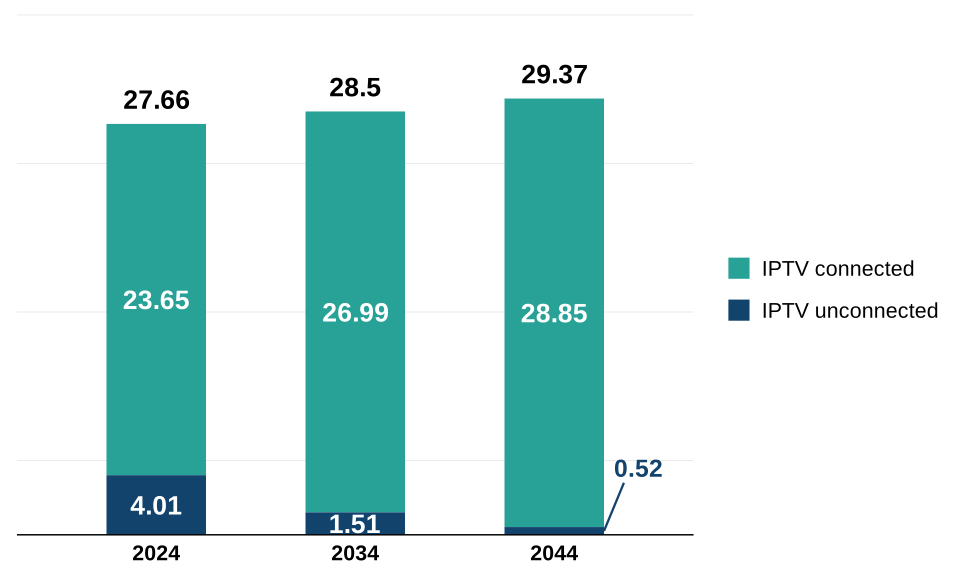
| Category | 2024 | 2034 | 2044 |
|---|---|---|---|
| IPTV connected | 23.65 | 26.99 | 28.85 |
| IPTV unconnected | 4.01 | 1.51 | 0.52 |
| Total | 27.66 | 28.5 | 29.37 |
Figure A2: Households without IPTV, 2024 to 2044 forecast (millions)
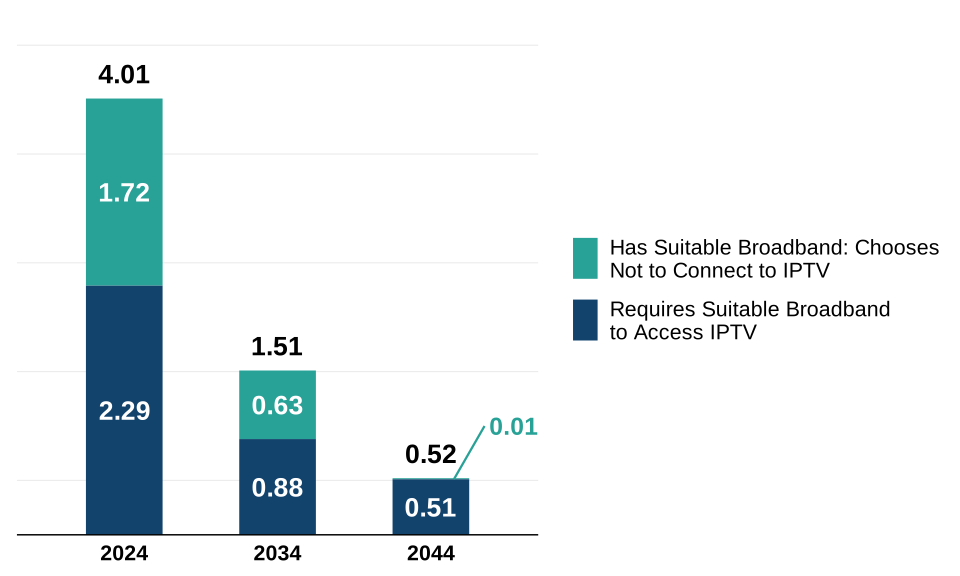
| Category | 2024 | 2034 | 2044 |
|---|---|---|---|
| Has suitable broadband: chooses not to connect | 1.72 | 0.63 | 0.01 |
| Requires suitable broadband to access IPTV | 2.29 | 0.88 | 0.51 |
| Total non-IPTV access | 4.01 | 1.51 | 0.52 |
Source: 3 Reasons, MTM (2024 and 2034 figures); DCMS (2044 figures)[footnote 68]
DCMS’ household forecasts reflect a sustained transition to IPTV up to 2044, driven by organic market uptake and the ongoing impact of existing infrastructure programmes. The reduction in the number of homes with suitable broadband that choose not to connect occurs as households naturally transition to IPTV. Simultaneously, the number of households with ‘unsuitable’ broadband (less than 30Mbps, see explanation above) also declines, underpinned by the continued national rollout of high-speed broadband.
The 2024 University of Exeter Report highlighted that age is a defining factor in a household’s connectivity status; individuals in the report’s unconnected TV segments were significantly older on average than those in more connected groups. In 2023, over 90% of individuals without a broadband connection were older than 55. This demographic concentration is expected to shift over time due to an ‘age cohort effect’, as younger, digitally native generations age into older brackets with a much higher propensity for broadband use. In contrast, only 9% of individuals in IPTV-only households were aged 55 or older in 2023.[footnote 69]
Households without IPTV access were also found by the report to belong to lower socioeconomic cohorts. As of 2023, 82% of households with no broadband connection were within the C2DE bands, alongside 55% of households with broadband but remain unconnected due to the lack of an IPTV-capable TV set. In contrast, Hybrid households demonstrated a more distributed profile with 41% to 44% belonging to C2DE bands, while 46% of the IPTV only households fell into these socioeconomic cohorts, suggesting that affordability remains a primary barrier for the remaining households reliant on traditional broadcast systems.[footnote 70]
The report also highlighted disparities between rural and urban areas. In 2025, approximately 9% of rural households across the UK lacked access to superfast broadband, compared to only 1% of those in urban areas. This gap was most pronounced in Scotland, where 13% of rural households remained without superfast coverage.[footnote 71] This suggests that infrastructure limitations in rural areas remain a significant barrier to achieving universal IPTV adoption. However, via Project Gigabit, the government is committed to achieving nationwide gigabit coverage and expects 99% of premises to have access to a gigabit-capable connection by 2032 which should largely address this issue prior to 2034.
Furthermore, access to personal connectivity beyond television follows a similar pattern among the most disconnected groups. In 2023, only 16 to 17% of individuals in broadband unconnected households owned a smartphone, compared to 97% of those in the IPTV-only segment. Ownership of a computer was even lower among these unconnected groups, between just 4 to5 % compared to 88% of individuals in the IPTV-only group.[footnote 72] This sharp contrast highlights that the absence of IPTV is often part of a broader trend of digital exclusion, where households lack the essential hardware to make use of internet-based services even when coverage becomes available.
DCMS’s forecasts for IPTV access differ from those in the University of Exeter report by accounting for the accelerating decline in non-VOD-capable connections. The number of fixed-line connections delivering less than 30 Mbps has halved over the last four years (from 1.18 million to 0.61 million), while ultrafast connections have doubled from 8.3 million in 2021 to 16.5 million at the end of 2024. By 2034, DCMS anticipates this momentum, coupled with the launch of new free-to-air IPTV services such as Freely (which were not considered in the University of Exeter report analysis), significantly erodes the segment of DTT-reliant households who previously chose not to connect despite having suitable access. Whilst broadband take-up in our current household data for under-65s is already near saturation at 98.7%, this model specifically targets the migration of the remaining demographic cohorts as user interfaces begin to mirror familiar DTT navigation. Therefore, further work is needed to understand how the demographic cohorts we discuss in the above paragraph have changed since 2023, and how we would expect them to shift in the future.
Social cost of broadband to households without broadband or IPTV-capable broadband
The present value broadband costs are estimated to be £1,600 million in Option 1 (2034 IPTV transition) and £200 million in Option 2 (2044 IPTV transition), which captures the effect of the social cost of adopting broadband subscriptions. This difference is driven primarily by the 10 years of additional annual broadband costs experienced by the 740,000 households in Option 1, reducing to 480,000 households over the 2034 to2044 period (see Figure 1). We calculate these broadband costs for all households that are not forecasted to have broadband (which includes satellite-reliant households). We assume households will adopt broadband of at least 30 Mbps, and use uplifted superfast listed prices from Ofcom’s report on pricing trends for communication services in 2025 to estimate this. We also consider that many households may have existing landline/voice-only service and only cost the price difference between a landline/voice-only service and a dual landline/voice-only and superfast broadband package.
Whilst Ofcom’s report shows that broadband prices have fallen in real terms in recent years, there is no evidence this will continue over a 19 year period, so we assume in the Central scenario that broadband prices remain the same as they currently are in real terms. However, to account for potential changes in prices, we assume in the Low scenario that broadband increases in cost by 10% over the appraisal period, and for the High scenario, broadband conversely decreases in cost by 10% over this period.
We also consider that some (8.6%) eligible households will adopt social tariff broadband prices (as per the most recent figure from Ofcom’s ‘Pricing and consumer engagement report’), which are considerably lower than traditional listed broadband pricing and are taken from Ofcom’s social tariff listings.[footnote 73] We identify eligible households by combining socioeconomic band information from the University of Exeter report[footnote 74] with eligibility data from Ofcom’s consumer research annex.
Broadband costs to households without broadband or IPTV-capable broadband
| Appraisal Period (2026 to 2044) | Option 1: Managed IPTV transition by 2034 |
Option 1: Managed IPTV transition by 2034 |
Option 1: Managed IPTV transition by 2034 |
Option 2: Managed IPTV transition by 2044 |
Option 2: Managed IPTV transition by 2044 |
Option 2: Managed IPTV transition by 2044 |
|---|---|---|---|---|---|---|
| Scenario | Low | Central | High | Low | Central | High |
| 2026 prices | £2,500m | £2,300m | £2,200m | £400m | £360m | £330m |
| 2026 prices, present value | £1,700m | £1,600m | £1,500m | £220m | £200m | £180m |
Final figures have been rounded to 2 significant figures
D. IPTV device costs to households without IPTV-capable devices
We cautiously estimate that all the non-IPTV households at the time of either transition (see Figure 2) do not have an IPTV-capable device and therefore will require one in order to access IPTV. We based our calculations on the original £69.99 Freely puck price before high demand and a global parts shortage forced a £20 increase.[footnote 75] We have used this baseline rather than a market average on the assumption that transitioning consumers will likely seek the most cost-effective option, and that the cost of this technology will decrease over time. We assume in the Central scenario that prices remain the same as they currently are in real terms. However, to account for potential changes in prices, we assume in the Low scenario that broadband increases in cost by 20% over the appraisal period, and for the High scenario, broadband conversely decreases in cost by 20% over this period.
IPTV device costs to households without IPTV-capable devices
| Appraisal Period (2026 to 2044) | Option 1: Managed IPTV transition by 2034 |
Option 1: Managed IPTV transition by 2034 |
Option 1: Managed IPTV transition by 2034 |
Option 2: Managed IPTV transition by 2044 |
Option 2: Managed IPTV transition by 2044 |
Option 2: Managed IPTV transition by 2044 |
|---|---|---|---|---|---|---|
| Scenario | Low | Central | High | Low | Central | High |
| 2026 prices | £160m | £150m | £140m | £44m | £37m | £30m |
| 2026 prices, present value |
£130m | £125m | £120m | £25m | £21m | £17m |
Final figures have been rounded to 2 significant figures.
E. Communications programme costs
The communications programme costs were estimated by uplifting the Digital UK’s planned expenditure for the Digital TV switchover communications campaign to 2026 prices, with updated mailing costs estimated from the cost of letters sent out for ONS surveys. In both options, this communications programme is conducted, but at different points to reflect the difference in transition date. For the central and high scenario, this accounts for TV, radio and press advertising; a call centre and website; planning and production; regional mailing; trade support; research and tracking; admin costs; as well as the operational costs of setting up an organisation (like Digital UK) to run the communications programme. For the low scenario, this list is restricted to only TV, radio and press advertising; regional mailings; and the admin costs of running these two elements.
Communications Programme (for example public awareness campaign, user support, and skills training)
| Appraisal period (2026 to 2044) | Option 1: IPTV Transition in 2034 |
Option 1: IPTV Transition in 2034 |
Option 1: IPTV Transition in 2034 |
Option 2: IPTV Transition in 2044 |
Option 2: IPTV Transition in 2044 |
Option 2: IPTV Transition in 2044 |
|---|---|---|---|---|---|---|
| Scenario | Low | Central | High | Low | Central | High |
| 2026 prices | £490m | £490m | £270m | £490m | £490m | £270m |
| 2026 prices, present value |
£410m | £410m | £230m | £290m | £290m | £160m |
Final figures have been rounded to two significant figures
F. DTT infrastructure costs
As the DTT infrastructure costs considered below only apply for Option 2 (a 2044 IPTV transition with 10 years of some remaining DTT infrastructure between 2034 to 2044), we have only provided costs and benefits for this option. The costs are primarily driven by the annual payments that multiplex operators pay to use the DTT infrastructure which amount to around £820 million in present value over the appraisal period.[footnote 76] However, Arqiva estimates that turning off DTT at the end of 2034 could see the cost of radio services increase relative to the position if DTT continues to 2045, resulting in ‘radio cost-savings’ (meaning a benefit) of around £160 million in Option 2.[footnote 77] This increase is spread across ongoing BBC and commercial radio services with the impact varying based on the extent to which the radio service currently shares sites with DTT. The modelling takes account a high-level estimate of the anticipated capital expenditure required to extend the life of radio services and includes an estimate of power costs.
Arqiva also estimates a 600 MHz clearance programme could cost in the region of around.£260 million based on a similar methodology, approach and learnings from other clearance events including 700 MHz clearance and digital switchover.[footnote 78] The estimated programme captures the necessary technical work covering main station and relay technical work, including transmitters service continuity planning, transition works, labour and contingency. It does not include any costs associated with managing or communicating with viewers or handling any interference issues which may arise.
Whilst we have not produced High and Low scenarios for this impact, as these figures are quoted from Arqiva and DCMS is not privy to negotiations between Arqiva and commercial users of the DTT mast network. All these figures would be subject to necessary negotiations and could potentially change.
DTT Annual Network Costs (costs that multiplex operators pay to infrastructure provider)
| Appraisal period (2026 to 2044) | Option 1 IPTV Transition in 2034 |
Option 1: IPTV Transition in 2034 |
Option 1: IPTV Transition in 2034 |
Option 2: IPTV Transition in 2044 |
Option 2: IPTV Transition in 2044 |
Option 2: IPTV Transition in 2044 |
|---|---|---|---|---|---|---|
| Scenario | Low | Central | High | Low | Central | High |
| 2026 prices | Not applicable | £0m | Not applicable | Not applicable | £1,300m | Not applicable |
| 2026 prices, present value | Not applicable | £0m | Not applicable | Not applicable | £820m | Not applicable |
Final figures have been rounded to 2 significant figures.
DTT radio cost-savings (benefit)
| Appraisal period (2026 to 2044) | Option 1: IPTV Transition in 2034 |
Option 1: IPTV Transition in 2034 |
Option 1: IPTV Transition in 2034 |
Option 2: IPTV Transition in 2044 |
Option 2: IPTV Transition in 2044 |
Option 2: IPTV Transition in 2044 |
|---|---|---|---|---|---|---|
| Scenario | Low | Central | High | Low | Central | High |
| 2026 prices | Not applicable | £0m | Not applicable | Not applicable | £250m | Not applicable |
| 2026 prices, present value | Not applicable | £0m | Not applicable | Not applicable | £160m | Not applicable |
Final figures have been rounded to 2 significant figures.
DTT 600MHz clearance programme costs (transmitter and antenna replacements, labour costs, etc)
| Appraisal period (2026 to 2044) | Option 1:IPTV transition in 2034 | Option 1: IPTV transition in 2034 | Option 1: IPTV transition in 2034 | Option 2: IPTV transition in 2044 | Option 2: IPTV transition in 2044 | Option 2: IPTV transition in 2044 |
|---|---|---|---|---|---|---|
| Scenario | Low | Central | High | Low | Central | High |
| 2026 prices | Not applicable | £0m | Not applicable | Not applicable | £310m | Not applicable |
| 2026 prices, present value | Not applicable | £0m | Not applicable | Not applicable | £260m | Not applicable |
Final figures have been rounded to 2 significant figures.
G. Alternative PSM usage of DTT funding
In Option 1 (2034 IPTV transition) and Option 2 (2044 IPTV transition), PSMs would be paying no DTT fees and reduced DTT fees respectively. Therefore a key unquantified impact is the opportunity cost of how PSMs could alternatively spend the funding, particularly in Option 1 where there are zero DTT fees. PSMs could bank savings to reinvest in and support the delivery of existing services under constrained funding pressures. Alternatively they could use the equivalent revenue for content and innovation, which could bring about substantial benefits to all audiences and the media sector in the UK, in turn promoting exports and growth.
As an indicative figure, BBC analysis prepared with assistance from EY indicates that, ‘for every £1 the BBC directly adds to the economy [direct GVA], £3.55 is generated in the UK economy as a whole [indirect and induced GVA]’.[footnote 79] PSM content is also important for bringing the country together and promoting shared values.
H. Impacts of releasing the 600 MHz and 500 MHz spectrum bands
DCMS and the Department for Science, Innovation and Technology (DSIT) jointly commissioned a report from Analysys-Mason and DotEcon which sought to identify the value of the ultra-high frequency (UHF) spectrum currently used by DTT (470-694 MHz) should some or all be released for use by a range of likely alternative services. For these purposes, the UHF spectrum used by DTT is divided into two bands, a 500 MHz band, covering 470 MHz to 614 MHz, and a 600 MHz band, covering 614 MHz to 694 MHz. This analysis does not imply that any decisions have been taken on future use of the UHF band. Ofcom is responsible for spectrum management in the UK, including future decisions on the allocation of different bands.
The DTT spectrum release options included:
- i) Releasing all of the UHF spectrum (both the 500 MHz and 600 MHz bands) in 2035
- ii) Releasing the 600 MHz band in 2035 and the 500 MHz band in 2045
- iii) Releasing the 600 MHz band and part of the 500 MHz band not retained for DTT in 2035
The first spectrum release option corresponds to a full switchover to IPTV delivery in 2034. The second option corresponds to an upgrade plan for the DTT multiplex arrangement, through the introduction of more efficient transmission technologies, where the existing six national DTT multiplexes would be reduced to a smaller set (of three) to deliver the same TV services. The frequencies used at DTT transmitters could thereby be reorganised to release the 600 MHz band.
The alternative services considered included:
1. Mobile telecommunications services (mobile phone/data services) 2. Programme Making and Special Events (PMSE) i.e. audio radio microphones, talkback etc 3. Energy network Utilities services (i.e. wireless communications to support gas/electricity/water networks) 4. Emergency Service Networks (ESN) 5. Transport services (wireless services that support public transport and other means of transport)
The UHF spectrum was found to have particular benefit for mobile telecommunications services to increase the capacity of the network and to improve coverage in rural areas and within buildings. For the consumer, this is expected to lead to a significantly improved user experience, particularly through more stable connectivity when traveling and more reliable access if their fixed broadband fails or is unavailable.
PMSE is an existing user that shares the spectrum intensively with DTT and is used to support music events and festivals, broadcast programme production and theatre productions. The Utilities, ESN and Transport services have other spectrum options available than the use of UHF, although UHF spectrum would provide further options and benefits beyond the other bands they could use.
Potential mobile network operators’ cost-savings
For mobile telecommunications services, the study showed that in a cost-saving maximising scenario measuring benefits between 2035 and 2055, the bulk (£3.1 billion) of the value[footnote 80] to mobile network operators (MNOs) would be delivered by release of the 600 MHz band in 2035 and 500 MHz spectrum in 2045 (release option 2 above). An additional around £400 million of value would be delivered by bringing forward the 500 MHz release to 2035 (with full switchover to IPTV in 2035) but this additional value was highly dependent on a mobile ecosystem developing in the 500 MHz band from 2035 onwards.
DCMS adapted the analysis from this report to calculate suitable scenarios for the purposes of our Cost-Benefit Analysis. There is one primary change we have made in comparison to Analysys Mason and DotEcon’s report. The report uses a ‘cost-saving maximising’ scenario for each option as its main scenario. However, we have used this as the High scenario to reflect that MNOs may not acquire all of the available spectrum in an collectively optimal way. To contrast this, for the Low scenario, we identified the ‘cost-saving minimising’ scenario in which the least cost-savings are made whilst still allocating the whole spectrum amongst the MNOs. Finally for the central scenario, we took a symmetrical approach, dividing the spectrum bands evenly between the MNOs[footnote 81], with a light preference towards the MNO who derived the most value from the spectrum when there was not an even amount to distribute.
Rather than using the social discount factor of 3.5% used in the Green Book, we used Analysys Mason and DotEcon’s recommendation of a 7.2% weighted average cost of capital (WACC) as the discount rate. We will explore these discount rates further in future analysis.
Potential mobile network operators cost-savings (via spectrum release)
| Appraisal period (2026 to 2054) | Option 1: IPTV transition in 2034 | Option 1: IPTV transition in 2034 | Option 1: IPTV transition in 2034 | Option 2: IPTV transition in 2044 | Option 2: IPTV transition in 2044 | Option 2: IPTV transition in 2044 |
|---|---|---|---|---|---|---|
| Scenario | Low | Central | High | Low | Central | High |
| 2026 Prices | £14,200m | £15,100m | £15,900m | £12,800m | £14,100m | £14,800m |
| 2026 Prices, present value | £3,300m | £3,500m | £3,600m | £2,800m | £3,100m | £3,200m |
Final figures have been rounded to 2 significant figures (or 3 significant figures for the 2026 prices).
The result of this adapted analysis shows that for the central scenario we are considering, the potential MNO cost-savings via spectrum release in Option 1 (2034 IPTV transition) are larger (around £400 million in PV) than in Option 2 (2044 IPTV transition).
Additionally, the likely costs of clearing DTT from the 600 MHz band in 2035 (through reducing the number of DTT multiplexes to three and making DTT transmitter frequency changes) are likely to be significantly less than the benefits to MNOs. This suggests that there would be merit to committing to clearing the 600 MHz band in 2035 if DTT were to continue until 2044.
Programme-making and Special Events (PMSE)
PMSE currently makes heavy use of the 500 MHz and 600 MHz bands, sharing with DTT, and delivers significant value to the creative industries. Usage is concentrated in certain geographical locations, for example, theatres and studios and in some locations may be restricted to periods of 1 to2 weeks in the year such as for music festivals.
The Analysys-Mason and DotEcon study identified the challenges to PMSE if DTT were to be cleared from the 600 MHz band and that band were to be reallocated to mobile, and also if DTT were to be switched off altogether. The study also identified alternative bands that could be used by audio PMSE under these DTT clearance scenarios. In addition, the study recognised the steady growth in demand for frequencies for PMSE, and how technology changes might help to support this growing demand. The study also briefly considered sharing opportunities between mobile services and PMSE, which was only thought possible with certain conditions and restrictions to ensure safe coexistence without harmful interference.
Many of the alternative bands have limitations, such as lack of available equipment (if those bands are not harmonised for use in other countries), higher levels of interference or relatively small blocks of spectrum being available. The largest alternative block of additional spectrum available to PMSE is in the 960-1164 MHz band that was previously made available in the UK to compensate for the loss of the 700 MHz band to mobile. Usage of that band has started to grow although equipment is less currently available than in the UHF band because other countries have yet to commit to use of that band for PMSE.
Ofcom has issued a Call for Information and we believe that responses to this and any potential future work should enable a clearer picture to emerge on the needs of the sector and the options for appropriate spectrum access.
Utilities, Emergency Services Network (ESN) and transport
Where dedicated spectrum is identified to be the most appropriate solution for these sectors, the amount required is expected to be significantly smaller than the spectrum needed to meet the needs of the mobile or PMSE sectors. Therefore, this could potentially be met using a small allocation in the 500 MHz band. This would be subject to any decision taken on the 500 MHz band and any future work by Ofcom on optimum spectrum usage.
I. Digital inclusion benefits
People who are digitally excluded often face worse outcomes than those who are not: they can pay more for essentials (research shows those who are digitally excluded can pay up to 25%[footnote 82] more for essentials like home insurance, train travel, and food); face greater difficulty engaging with health and public services; and experience worse employment outcomes (the digitally excluded are two to three times more likely to be unemployed[footnote 83]), and those with poor digital skills earn 3 to 9% less). Outcomes consistently show that improving digital capability and confidence delivers both individual and fiscal benefits, particularly when support is well timed and grounded in people’s everyday needs.
DSIT has conducted an initial assessment of the potential benefits from a digital inclusion support package. This has been modelled based on the scenario of supporting digitally excluded individuals to gain Life Essential Digital Skills (those required to be digitally proficient in day-to-day life, including setting up and using online accounts, and being safe online). The analysis draws upon the economic research in Good Things Foundation’s report on the benefits of digital inclusion[footnote 84], and uses population data to account for the demographic characteristics of the digitally excluded (more likely to be older, out of work and with a disability). These benefits are described in Table 1 below.
DSIT’s initial analysis of these benefits has found that, in the central scenario, the modelled digital inclusion support package could deliver benefits of around £2,314 per supported individual over 10 years (2026 prices, discounted), depending on the level of adoption of these digital skills. Given the evidence DSIT has about the cost of delivering other digital inclusion support, we are confident that on average it will cost less than this amount to support a digitally-excluded individual to gain Life Essential Digital Skills, and therefore a digital inclusion support package is expected to be value for money. This analysis has not been included in the quantified impacts (cost-benefit) analysis table, and will continue to be developed as any support package is designed and more evidence becomes available. Whilst we have not yet monetised the digital inclusion benefits due to the earlier transition in Option 1, we would expect these benefits to be larger in this option.
There is likely a significant overlap between those who are digitally excluded and those who exclusively view DTT. The University of Exeter report found that 92% of DTT-reliant households without broadband were over 55, 58% came from the two lowest socioeconomic bands and 41% were people with a disability.[footnote 85] There is a wide range of evidence demonstrating how broader digital inclusion drives personal and wider benefits.
Table 1: Assessment of Potential Benefits by Category
1. Individual benefits
| Benefit | Applicability and qualitative assessment |
|---|---|
| Increase in earnings | Low impact. By the time of the transition (2034), a significant proportion of the DTT-only households will be 65 plus and less active in the labour market. |
| Improvement in employment outcomes | Low impact. Similarly, due to the significant proportion of 65 plus individuals. |
| Greater consumer savings (for example, better info/avoiding scams) | Applicable but with caveats. Digital inclusion does not automatically translate into increased digital literacy for this older demographic; internet access could increase the risk of scams rather than reduce it. However, retail transactional benefits are relevant. Although the average value of online transactions is smaller for those aged 65+, this group is expected to drive more than three-quarters of overall gains due to their sheer numbers among those receiving “those receiving ‘upskilling’”. [footnote 86] Research by the Centre for Social Justice in 2023 found that those offline often pay a premium for everyday products and services.[footnote 87] |
| Time savings | Applicable. Conducting personal transactions online is expected to provide time savings and is considered a welfare gain, allowing individuals more time for enjoyable pursuits. ONS statistics show increasing internet access and online shopping among adults aged 65 and over.[footnote 88] |
| Improved well-being | Applicable. Digital exclusion is associated with lower well-being scores (0.8 to 0.9 points lower on a 10-point scale). Connecting this group is expected to mitigate this exclusion-related exclusion-related deficit.[footnote 89] |
2. Business benefits
| Benefit | Applicability and qualitative assessment |
|---|---|
| Corporate savings from job vacancies being filled | Low impact. The demographics becoming digitally included (primarily 65 plus) will largely be less active in the labour market. |
3. Government benefits
| Benefit | Applicability and qualitative assessment |
|---|---|
| Government efficiency savings | Applicable. This benefit is tied to the expected increase in the uptake of online government transactional services as a result of digital inclusivity. Assuming a number of adults are upskilled and use these services, this is a realisable monetary saving for the UK government.[footnote 90] |
| Improved government revenue | Low impact. This benefit relies on increased earnings and employment, which is less relevant given the demographic composition of those being digitally upskilled. |
4. Other benefits
| Benefit | Applicability and qualitative assessment |
|---|---|
| Reducing demand for avoidable GP consultations | Applicable. This is a quantifiable benefit tied to the monetary value of reduced GP appointments by upskilling.[footnote 91] |
| Environmental benefits | Applicable but with Caveats. Environmental benefits that are based on assumptions of increased working from home are less applicable to a demographic less active in the labour market. However, environmental benefits from shifting consumers to online retail; using GOV.UK and local portals cuts the environmental impact of physical document production and distribution; and reducing travel pollution by enabling access to healthcare and government services via connected devices instead of physical commutes could all be relevant. |
The benefits to individuals of a transition to IPTV translates features into social outcomes across three pillars:
1. Social inclusion (well-being)
Digital exclusion is linked to a 0.8 to 0.9 point deficit on a 10-point well-being 10 point well-being scale.[footnote 92] Broadband adoption could mitigate this deficit by facilitating social connection and accessing essential services. For rural residents, the inclusion benefit is the removal of geographic isolation. Broadband connections enable remote support models, where caregivers or family can assist with device setup and troubleshooting from a distance, reducing the feeling of being ‘left behind’ in a digital-first society. DCMS commissioned DCMS commissioned research shows TV can provide companionship for the socially isolated.[footnote 93] IPTV can address this by providing hyper-local and culturally specific content (for example, international or faith-based channels) in a way that DTT cannot. Furthermore, the higher bandwidth of broadband allows for remote support for TV setup and troubleshooting, which can be critical for maintaining social connection.
2. Economic inclusion
The ‘economic inclusion’ of broadband adoption and IPTV transition is primarily felt through retail and time savings rather than employment, as 92% of the target group were aged over 55 in 2023, so a similar proportion are likely to be aged 65 plus by 2034. Thus benefits related to earnings, employment outcomes, or corporate vacancy savings will have a reduced impact as the 65 plus group will have less employment-related benefits. However, there will still be some employment impacts to this age group: around1.5 million over 65s were in work in 2022 according to the ONS; retirement age will be 67 by 2034; and this group may still engage in volunteering and unpaid work.
However, there are retail transactional benefits, as those ‘offline’ often pay pay a ‘poverty premium’ for products.[footnote 94] Broadband connectivity can upskill users to access online savings, which is significant given the demographic prominence of the 65 plus group. Furthermore, online personal transactions provide a welfare gain through time saving, allowing more time for enjoyable pursuits. One caveat here is that increased internet access for this demographic could increase the risk of scams if digital literacy does not keep pace with technical access.
3. Functional inclusion (accessibility)
A current barrier to digital inclusion is cognitive accessibility, as many older users find DTT familiar and safe. Additionally, a migration to IPTV does not inherently improve digital skills. Older individuals with low digital confidence require structured support to overcome this hurdle. Transitioning these users requires user interfaces (UIs) that replicate the ‘live-first’ experience. By providing an interface (like Freely) that mirrors familiar DTT navigation while utilising internet delivery, users undertake a gradual digital introduction through familiar TV controls. This lowers the cognitive barrier to digital tools by embedding them within a daily habit they already value, watching television. Adding AI-driven features like advanced audio description and voice controlled navigation allows users with visual or physical impairments to access content in a way that was technically impossible on limited-bandwidth DTT.
A managed transition to IPTV, with an associated support package, could also create wider benefits to government efficiency or the environment allowing households to access digital services:
1. Government efficiency
A primary component of this ‘digital dividend’ is the reduction in demand for avoidable GP consultations, as digital upskilling allows older and vulnerable cohorts to manage health requests through more efficient online triaging and consultation tools. Furthermore, increasing the uptake of online transactional services reduces the administrative burden on central government departments and local authorities, providing a realisable monetary saving by decreasing the volume of paper-based processing and call centre volume..
2. Environment
The IPTV transition provides a unique opportunity to achieve environmental benefits by integrating historically offline cohorts into the digital economy. By bridging the digital divide, this transition facilitates a shift from physical to digital interactions, reducing the carbon footprint associated with traditional retail and physical government service delivery. While environmental benefits of working from home likely do not apply due to the demographic profile of the affected cohort, environmental benefits can be achieved through:
- Online retail: Shifting consumers online reduces reliance on energy-intensive physical stores.
- Digital government services: Using GOV.UK and local portals cuts the environmental impact of physical document production and distribution, saving resources and reducing mail waste.
- Reduced travel pollution: Enabling access to healthcare and government services via connected devices eliminates physical commutes.
Other considerations on evaluating digital inclusion benefits:
It should not be assumed that 100% of the TV households without broadband will connect to the internet in an IPTV transition. If even a small proportion do not connect to the internet, this creates the risk of secondary exclusion. Even for those who do connect, there is no guarantee they will engage digitally beyond usage of an IPTV. A key question for assessing digital inclusion benefits is determining how many of this group will actually become digitally included under the IPTV transition. Additionally, there is a lack of granular data on how users with cognitive impairments or neurodiversity will handle the shift from linear DTT interfaces to app-based interfaces.
Therefore, while the IPTV transition solves the access problem for this cohort, which is a prerequisite for achieving all digital inclusion benefits, it only generates functional inclusion and specific social inclusion benefits (meaning, those directly related to TV). Realising the substantial economic, government, and environmental benefits requires successful cross-device adoption and effective digital skills development
Annex D: Bibliography
Assessing the value and alternative uses of DTT spectrum for the future of UK TV distribution. Analysys Mason and Dot Econ. April 2026.
Award of 700 MHz and 3.6-3.8 GHz spectrum by auction. Ofcom. November 2024.
Connected Nations UP Report 2025. November 2025.
Digital Inclusion UK Economic Impact. Good Things Foundation. July 2024.
Future of TV Distribution Stakeholder Forum - terms of reference. Department for Culture, Media and Sport. November 2024.
Future of TV Distribution, A report prepared by the University of Exeter with the University of Leeds, MTM, 3 Reasons and Real Wireless. October 2024.
Future of TV Distribution: Early market report to government. A report prepared by Ofcom. May 2024.
Government Digital Inclusion Action Plan: First Steps. February 2025.
Government preparations for digital switchover. House of Commons Committee of Public Accounts. Twenty–eighth Report of Session 2007to 2008.
Identifying challenges and solutions for improving inclusivity and usability in the consumption of internet delivered television. Ofcom. September 2025.
Internet access - households and individuals, ONS. August 2020.
Is the government doing enough to tackle the impact of digital exclusion on unemployment? – Digital Poverty Alliance. December 2024.
Left Out: Digital Inclusion and the Most Excluded, Centre for Social Justice. August 2023.
Memories and Dementia: Starting the Conversation season launches at the BBC. March 2025.
Ofcom Code on television access services. Ofcom. July 2024.
Ofcom list of providers of social tariffs.
Ofcom television and on-demand programme services: Access services report. December 2024.
Ofcom work on implementing the 2024 Media Act.
Pricing and consumer engagement 2025: interactive report. Ofcom. February 2026.
Prominence and Accessibility on Connected TV Platforms - Consultation on our draft Code of Practice and draft Guidance on the Agreement Objectives. Ofcom. January 2026.
Promoting competition and investment in fibre networks: Telecoms Access Review 2026 to 2031. Ofcom. December 2025.
Public Sector Equality Duty: guidance for public authorities. GOV.UK. December 2023
Public Service Media Review. Ofcom. July 2025.
Sky response to Ofcom consultation on its draft report to the Secretary of State. September 2025.
Socio Economic Impact of Digital Transition. June 2025.
Stakeholder forum paper. Universality in future of TV distribution. April 2026.
Stakeholder forum paper. Television Usability in the future of TV experience. April 2026.
Stakeholder forum paper. IPTV ecosystem readiness. April 2026.
Stakeholder forum paper. Television competitiveness and sustainability of PSB ecosystem. April 2026.
Stream On: The Future of UK TV: A report for Sky prepared by Oliver & Ohlbaum Associates Ltd, January 2026.
Tackling the barriers to financial and digital inclusion. WPI Economics, December 2024.
The connected TV platform market - An update on our work. Ofcom. December 2024.
The Future of TV distribution. A report prepared by Revealing Reality. March 2025.
Transmission Critical - The future of Public Service Media. Ofcom. July 2025
Up next — the government’s vision for the broadcasting sector. Government white paper. April 2022.
Glossary of terms
| Term | Definition for this paper |
|---|---|
| Accessibility | The extent to which all users, including disabled people, are able to have equivalent access to a product or service. |
| Affordability | The extent to which a household can reasonably take up and sustain the broadband, devices and digital support needed to access IPTV services without having to reduce essential spending elsewhere. |
| Carriage | The act of a service provider distributing a specific channel or signal on its system. |
| Channel | A linear or live TV service. |
| Content Delivery Networks (CDNs) | A geographically distributed group of servers (specialist computers) that work together to provide fast delivery of internet content to the user. |
| Digital inclusion | Ensuring that everyone has the access, skills, support and confidence to participate in and benefit from our modern digital society, whatever their circumstances. |
| Digital literacy | The ability of an individual to find, evaluate, and communicate information clearly through various digital platforms. |
| Distribution ecosystem | The network of hardware, software, platforms, infrastructure, and entities that work together to deliver television to the end consumer. |
| Digital terrestrial television (DTT) | Digital terrestrial television (DTT) has been the most popular way to receive TV in the UK since the digital switchover. Also known to audiences as Freeview, it sends TV content to premises over radio spectrum via an aerial. |
| Free-to-air | Broadcast services that can be accessed without a subscription. For example, BBC, ITV, Channel 4 and 5 are some channels that provide free-to-air content. |
| Functional Inclusion | Functional Inclusion is about making the new internet TV feel just like your old television, especially for people who are less confident with technology. It uses familiar channel buttons and TV guides, and adds new, easy-to-use features like improved audio description and voice controls |
| Hybrid | Platforms capable of receiving more than one form of distributed content. This can be achieved in a number of ways including via a user interface which combines access to DTT and IPTV, or supplemental access to IPTV such as through a ‘smart stick’. |
| Industry | Refers to the full ecosystem of organisations that influence the affordability, accessibility, and use of digital services. This includes, but is not limited to: service providers (e.g. telecommunications, broadcasters, and streaming services); technology platforms and device manufacturers; financial and payment service providers; major retailers and e-commerce platforms; infrastructure providers; advertisers and content distributors; regulators and public bodies; and organisations representing consumers, audiences, and digitally excluded groups. It also includes sectors that may not traditionally see themselves as having a role in affordability, but whose products, pricing, or business models shape the overall cost and experience of digital participation, as well as those who stand to benefit from the transition more broadly. |
| Internet Protocol (IP) | A set of international standards which govern the distribution of content over the internet in a way that allows receiving devices to access that content in a consistent manner. |
| Internet Protocol Television (IPTV) | Internet Protocol Television (IPTV) is TV-like content delivered over the internet, including on-demand services and live broadcast channels, for example BBC iPlayer and Freely deliver free-to-air IPTV services to internet capable televisions. |
| Linear TV | Refers to content that is broadcast according to a schedule. It can be watched either live (at the time it is scheduled) or delayed by pausing live TV or using a recording device. It excludes on-demand services. |
| Mbps | Mbps means megabits per second, which is simply a way of measuring how fast data moves through your internet connection. |
| Media literacy | Media literacy the ability to use, understand and create media and communications across multiple formats and services. |
| Multiplex | A DTT multiplex, or “mux,” is a method of broadcasting multiple television channels, radio stations, and data services simultaneously over a single radio frequency. |
| Multiplex licence | A multiplex licence grants broadcasters the right to use specific radio spectrum frequencies to transmit digital television channels and services over-the-air via antennas. |
| On-demand TV | A way of watching television that allows users to access specific content whenever they choose, rather than following a fixed schedule. For example watching content after it has been broadcast on BBC iPlayer. |
| PMSE | Programme Making and Special Events. The ecosystem used to support broadcasting, news gathering, theatrical productions and special events, such as culture events, concerts, sport events, conferences and trade fairs. This includes multi-channel in-ear Monitors (IEMs) and wireless microphones. |
| PSM providers | PSM providers is used in this document as opposed to public service broadcasters (PSBs) to reflect how the BBC, ITV, Channel 4, 5, STV and S4C have moved on from delivering public service value solely through their broadcasting operations, to delivering this across a range of media output, such as video-on-demand services. |
| PSM content | Content provided by PSM providers that meets the definition of public service content and contributes to their public service remit. |
| Reliability | A reliable service is one that is generally consistent in terms of its availability and quality. |
| Resilience | A resilient service (or ecosystem) is one that can withstand, or recover quickly from, external challenges and events, such as natural disasters or criminal activity. |
| Satellite broadcasting | The distribution of television via signals bounced off satellites in geostationary orbit to antennas on the ground. For example, one way Sky distributes television is via satellite. |
| Set-top Box | A set-top box is a small device that connects to a television to receive digital signals from sources like cable, satellite or the internet. It allows access to channels, streaming services, and on-demand content. |
| Spectrum | Spectrum (or radio spectrum) is the range of invisible electromagnetic waves that enable all wireless technology, from our mobile phones, Wi-Fi and Bluetooth devices to aircraft navigation, satellite applications and Digital Terrestrial Television (DTT), among many others. |
| Stakeholder Forum | The Future of TV Distribution stakeholder forum brought together organisations and individuals from the TV industry, infrastructure partners, audience advocacy groups, the regulator and government. The forum produced 12 papers in total shortly to be published on GOV.UK. |
| Universality | The ability of people of all backgrounds to access TV content which is valuable to them, through which they are connected to others across the UK. Universality ensures not only that everyone has ready access to a reliable source of news and information, but also to a range of differing opinions and cultural experiences of life in the UK. |
| Usability | An umbrella term encompassing both traditional TV access services (e.g. subtitling and audio description) and the ease of use of a TV user interface for all audiences. |
-
The term PSM providers is used in this document, as opposed to public service broadcasters (PSBs), to reflect how the BBC, ITV, Channel 4, 5, STV and S4C have moved on from delivering public service value solely through their broadcasting operations to delivering this across a range of media output, such as video-on-demand services. ↩
-
Enders Analysis, Broadcasting consolidation - European content needs scale, 2026, page 12 ↩
-
Ofcom, News Consumption in the UK, 2025, page 12. ↩
-
Ofcom, Media Nations, 2025, page 19. ↩
-
Enders Analysis, YouTube - Becoming more TV-like, 2024, pages 9 to 11. ↩
-
House of Lords, Social media, misinformation and harmful algorithms, Second Report of Session 2024–25, 2025, page 16. ↩
-
Ofcom, Media Nations, 2025, page 22. ↩
-
Ofcom, Children’s Media Lives Summary Report, 2025, pages 54 to 55. ↩
-
Reuters Institute for the Study of Journalism, Digital News Report 2025: United Kingdom, 2025, page 26. ↩
-
Ofcom, News Consumption in the UK, 2025, pages 8 to 9. ↩
-
Luca Rossi et al., Algorithms, Attention, and the Spread of Misinformation, 2024, page 2. ↩
-
Ofcom, News Consumption in the UK, 2025, pages 7 to 12. ↩
-
Ofcom, News Consumption in the UK, 2024, page 11. ↩
-
BBC, Audience Use and Perceptions of AI Assistants for News, 2025, page 3. ↩
-
Ofcom, Understanding Misinformation: UK Adults’ Behaviour and Attitudes, 2024, pages 4 to 9. ↩
-
PACT, TV Television Production Survey, 2025, page 9. ↩
-
Ofcom, Pricing and consumer engagement report, 2026, page 77. ↩
-
Ofcom, Transmission Critical, 2025, page 16. ↩
-
Public service content as defined by section 264 of the Communications Act 2003. ↩
-
Ofcom, The relationship between the use of PSBs for news and societal outcomes: An empirical analysis, 2025, page 4. ↩
-
Pact, TV Production Census 2025 - Nations and Regions Annex, 2025 pages 2 to 7. ↩
-
Ofcom, Media Nations, 2025, page 35. ↩
-
Ofcom, Transmission Critical, 2025, page 5. ↩
-
Based on licence fee income reporting from annual TV Licensing, BBC Trust Statement: TV Licence Fee, Trust statement for the year ending 31 March 2025, 2025. ↩
-
Ofcom, Transmission Critical, 2025, page 5. ↩
-
UK Government, Creative Industries Sector Plan, 2025, pages 43 to 47. ↩
-
Pact Census, Oliver & Ohlbaum Associates, UK Television Production Survey, Financial Census 2025, 2025, page 15. ↩
-
‘High-end television’ is a drama, documentary, or comedy intended for public broadcast, with a minimum core expenditure of £1 million per hour and a slot length exceeding 20 minutes. ↩
-
Pact Census, Oliver & Ohlbaum Associates, UK Television Production Survey, Financial Census 2025, 2025, page 15. ↩
-
Ofcom, Media Nations, 2025, page 18. ↩
-
Ofcom, Top trends from our latest look at the UK’s news habits, 2025, page 5. ↩
-
BBC, Representation of BBC News content in AI Assistants, 2025, page 2. ↩
-
Ofcom, Understanding misinformation: an exploration of UK adults’ behaviour and attitudes, 2024, page 10. ↩
-
Ofcom, Understanding misinformation: an exploration of UK adults’ behaviour and attitudes, 2024, page 4. ↩
-
Ofcom, Understanding misinformation: an exploration of UK adults’ behaviour and attitudes, 2024, page 4. ↩
-
Park, S., Lee, J.Y., Notley, T. and Dezuanni, M., Exploring the relationship between media literacy, online interaction, and civic engagement, 2023. This research was conducted with a national sample of 3,510 Australian adults, and measured media literacy using confidence in media abilities as a proxy. ↩
-
Ofcom, News Consumption in the UK, 2025, page 5. ↩
-
Reuters Institute for the Study of Journalism, Digital News Report, 2025, page 67. ↩
-
House of Lords Communications and Digital Committee, Written evidence from BBC Education and BBC News to the Media literacy Inquiry, 2025, page 3. ↩
-
The Behavioural Insights Team, Media Literacy Uptake Among Hard-to-Reach Citizens, 2023, page 5. ↩
-
Department for Culture, Media and Sport, Future of TV Distribution, 2024, page 7. ↩
-
Households that have both IPTV access and use another form of TV distribution. See Figure 6. ↩
-
Department for Culture, Media and Sport, Future of TV distribution audience research 2025, page 9. ↩
-
Please see Glossary of Terms for definition. ↩
-
PWC, Socioeconomic Impact of Digital Transition, 2025, page 57. ↩
-
The Department for Culture, Media and Sport, Future of TV Distribution 2024, page 8 and 65. ↩
-
Ofcom, Media Nations, 2025, page ↩
-
Ofcom, Media Nations, 2025, page ↩
-
Ofcom, Media Nations, 2025, page ↩
-
Enders Analysis, Viewing Trends in 2025, 2026, page 3 ↩
-
European Broadcasting Union, Public service media as an antidote to polarisation, 2024, page 20 ↩
-
Ofcom, Transmission Critical, 2025, page 14 ↩
-
Streamers include advertising on-demand and subscription on-demand services. ↩
-
Enders Analysis, Viewing trends in 2025, 2026, pages 3 to 5 ↩
-
Enders Analysis, Viewing Trends in 2025, 2026, page 3 ↩
-
Ofcom, Transmission Critical, 2025, pages 5 to 13 ↩
-
Ofcom, Future of TV Distribution Report, 2024, page 7. ↩
-
Most major UK Digital Terrestrial Television (DTT) multiplex licences expire on 31 December 2034. This option would mean no further extension. ↩
-
Department for Culture, Media and Sport, Future of TV distribution audience research, 2025, page 6. ↩
-
Please see the Glossary of Terms for full definition. ↩
-
As estimated by 3 Reasons Ltd ↩
-
Based on DCMS extension of the 3 reasons forecast ↩
-
Industry consensus is that ‘superfast’ broadband (at least 30 Mbps) is the minimum for reliable delivery of video streaming over IP; Department for Culture, Media and Sport, Future of TV Distribution, Page 46 ↩
-
N.B. All of these figures are estimations on the best available data, but there is a high level of uncertainty when forecasting a 20 year time horizon. ↩
-
This was done by extrapolating 3 Reasons data by an additional 10 years. Therefore, this forecast has higher uncertainty in the later years of the forecast period. ↩
-
Department for Culture, Media and Sport, Future of TV Distribution, Figure 22. ↩
-
Department for Culture, Media and Sport, Future of TV Distribution, Figure 26 ↩
-
Ofcom, Connected Nations UK Report 2025, Table 2.7 ↩
-
Department for Culture, Media and Sport, Future of TV Distribution, Figure 34 ↩
-
Ofcom, Social tariffs: Cheaper broadband and phone packages, 23 February 2026 ↩
-
Department for Culture, Media and Sport, Future of TV Distribution, Page 38 ↩
-
Freely, Manhattan Aero 4K TV Streamer, price as of February 2026 ↩
-
Arqiva provided DCMS figures on DTT Network costs, radio costs, and 600 MHz clearance programme costs in 2024 prices which have been inflated to 2026 prices using a GDP deflator and discounted using the Green Book recommended social discount rate. ↩
-
This is an estimate only and does not represent an offer from Arqiva capable of acceptance. ↩
-
This estimate may change based on the project’s final timing and details. This document is for discussion only and is not a binding contract offer. ↩
-
BBC, A BBC For All: Our response to the government’s Green Paper, 2026. ↩
-
Note that this value is an estimate that all MNOs would derive from access to the spectrum, to save on having to further densify their networks. It is not the likely price which would be paid at a spectrum auction, which would be lower. ↩
-
This is consistent with the sale of the 700 MHz spectrum where it was allocated evenly between MNOs: Ofcom - Award of 700 MHz and 3.6-3.8 GHz spectrum by auction, 26 February 2026. ↩
-
Left Out: How to tackle digital exclusion and reduce the poverty premium - The Centre for Social Justice ↩
-
Is the government doing enough to tackle the impact of digital exclusion on unemployment? – Digital Poverty Alliance ↩
-
Good things foundation, UK Economic Impact of Digital Inclusion, 2024. ↩
-
Department for Culture, Media and Sport, Future of TV Distribution, Figure 21. ↩
-
Good Things Foundation, Digital Inclusion UK Economic Impact, 2024. ↩
-
Centre for Social Justice, Left Out: Digital Inclusion and the Most Excluded, 2023. ↩
-
ONS, Internet access - households and individuals, Great Britain, 2020. ↩
-
WPI Economics, Tackling the barriers to financial and digital inclusion, 2025. ↩
-
Good Things Foundation, ‘Digital Inclusion UK Economic Impact’, 2024. ↩
-
Good Things Foundation, Digital Inclusion UK Economic Impact, 2024. ↩
-
WPI Economics, Tackling the barriers to financial and digital inclusion, 2025. ↩
-
Revealing Reality: Future of TV distribution: Research report, 2025. ↩
-
Centre for Social Justice, Left Out: Digital Inclusion and the Most Excluded, 2023. ↩